by
by  Do you review your website's metrics on a regular basis?
Are you struggling to figure out how you can better use the data?
To know which of your marketing efforts are most successful, you need to look beyond the numbers. Explore what they mean and figure out what parts of your strategy need to be adjusted to increase your reach.
Here are five ways metrics can improve your social media marketing.
#1: Determine Which Stats Matter
Before you enter into any metrics analysis, decide what you need to track and how you'll track it. Google Analytics is clearly the go-to, although there are other analytics sites. Most social channels have their own insights, as well.
For an overview, check out Kevan Lee’s article, Which Stats Matter: The Definitive Guide to Tracking Social Media Metrics on the BufferSocial blog.
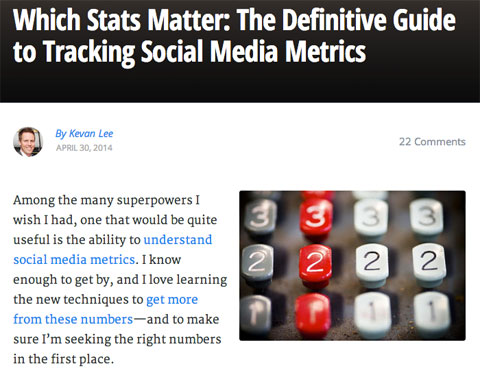
The article asks this important question: “What are you hoping to get from your social media marketing?” What you track will be different for each answer, whether you want to optimize for sharing, click-throughs, signups or even just visits.
Lee delves into the types of metrics to track, key tools, metrics definitions and conversions. Plus he goes into detail in a variety of scenarios—engagement vs. reach, retweets vs. clicks, traffic/day vs. traffic/post, page views vs. attention and more.
This resource has plenty of information to help you prioritize your metrics.
#2: Analyze Your Content Strategy
In all social strategy, content is key. Find which content gets the best response so you can create more of it.
“At the heart of any content marketing strategy is the editorial calendar,” explains Ben Harper in his article, How to Use Data to Improve Your Content Marketing Strategy on Content Marketing Institute.
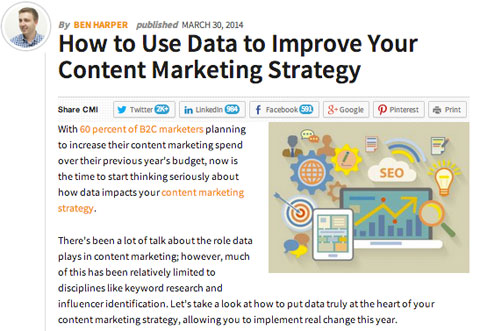
Ben suggests creating a table with your blog’s content data, and then track key performance indicators like site visits and conversions (per Google Analytics), as well as engagement.
Once you create a chart for your own original content, see what data you can compile from competitors, guest posts and even your social media posts.
With everything laid out by the numbers, look at what content gets the best performance and strategize accordingly. This will improve traffic and generate more engagement, conversions and customers.
3 Days of World-Class Training—Zero Travel!

Couldn't make it to Social Media Marketing World and AI Business World this year? Get all of the great content at a fraction of the price with a Virtual ticket.
That’s full access to recordings of every keynote, workshop, and session—the ones people travel thousands of miles to see. Don't wait. Get your Virtual ticket and enjoy actionable content that you can watch anytime, anywhere.
🔥 Save $200 on Virtual tickets. Sale Ends Friday! 🔥
GET YOUR VIRTUAL TICKET NOW“Taking a data-led approach to your content marketing not only gives you a stronger strategy,” Ben explains, “but also allows you to identify new opportunities from your competitors' activity and your audiences' preferences.”
#3: Track Post Performance
There is immense value in building and maintaining your online community. Equally as important to looking at what content is most popular is looking at what content converts best so you can create more of it to get more leads.
Ian Cleary of RazorSocial explains in his article, Social Media Tracking: 5 Simple Techniques to Track ROI, that you should have a goal—whether it's visits, signups, sales, ad clicks or other action items.
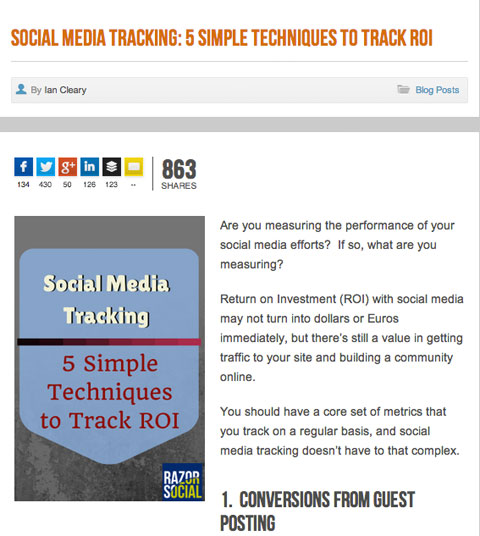
The five techniques Ian recommends for tracking are:

Want to Unlock AI Marketing Breakthroughs?
If you’re like most of us, you are trying to figure out how to use AI in your marketing. Here's the solution: The AI Business Society—from your friends at Social Media Examiner.The AI Business Society is the place to discover how to apply AI in your work. When you join, you'll boost your productivity, unlock your creativity, and make connections with other marketers on a similar journey.
I'M READY TO BECOME AN AI-POWERED MARKETER- Conversions from guest posting: Guest posts can result in immediate and ongoing traffic. However, you must engage with your new audience to see which sites convert best, and also add value so the new visitors return. Check All Referrals in Google Analytics to see which sites give you the best traffic.
- Conversions from your own blog content: While some blog content converts well, some may not do as well. To see your content conversions, go to Google Analytics. Be sure to set up the goal in the Admin screen beforehand. Select Behavior > Site Content, > Landing Pages to see the conversion rate of your blog posts. Analyze what influenced the higher conversions.
- Conversions from social media campaigns: What social sites are most beneficial to your brand? Check Network Referrals under Social in Google Analytics to see which ones your readers are coming from.
- Tracking specific shared campaigns: To do comparisons when you share the same content on different social channels, use custom URL builders. This is also helpful when you want to compare results for advertised links vs. organic shares.
Tracking the value of awareness and engagement: Track where your leads come from, whether you use the social channel's insights or an outside app. Ian recommends using a tool like LeadSocial to do this kind of research.
Technology makes it easy to see where activity comes from. Replicate the actions that have the most conversions so you can get the most benefits.
#4: Measure Marketing Success
Leads are great. Sales are even better. Use metrics to measure the effectiveness of your campaigns so you can assess and alter them for future marketing efforts.
To do this, Heidi Cohen suggests three types of marketing success metrics: counting things, developing rates and assessing things over time.
- Counting things. At minimum, Heidi says, track numbers for the following: sales (gross sales, returns and net sales), purchasers (contacts, prospects, customers and advocates), costs (variable and fixed) and items (broken down by type and category, depending on your business).
- Developing rates. To understand marketing effectiveness, you need to examine certain items in relation to one another, such as people's response and conversion rates, and items' order rates and size of orders. In terms of sales, track sales per customer, average sale and value. For costs, look at costs per media viewer reached, costs per buyer and costs per contact.
- Assessing things over time. Analyze items over various periods of time, ranging from hours and days through months, years or marketing campaigns. Choose times based on your business so you can track trends, and also see what works best at what times for your business.
Heidi shares a simple framework that can be scaled down to suit smaller businesses or expanded for larger ones, based on need. The key is to keep these numbers in mind for future business so you can develop it and increase sales over time.
#5: Review Website Traffic
If people can't find your site, what's the point of having one? Make sure your site is getting consistent and growing traffic. If it isn't, find out why.
In 3 Steps to Diagnosing Declining Website Traffic, Christopher Penn explains that the way to understand your website traffic is audience, acquisition and behavior. Christopher takes you along on his journey to diagnose and correct his own site traffic problems so you can do the same.
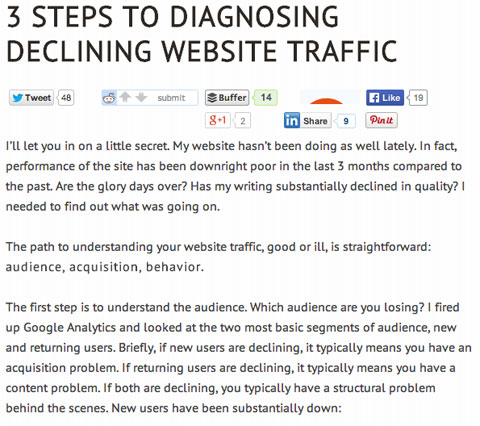
- Audience: Go to Google Analytics and look at new vs. returning visitors in Audience reports. If new users are declining, it usually means you have an acquisition problem. A decline in returning users could mean a content problem. If it's both, it could be a structure problem. Christopher was having challenges with both.
- Acquisition: If you're losing traffic, it's important to locate the disconnect. Lost traffic from returning users means people have lost bookmarks, forgotten to type in the domain or don't look for your site via search. For new visitor decline, organic and search are the culprits.
- Behavior: To look into the problem, Christopher went over to Google's Webmaster Tools. Turns out his sitemap panel wasn't indexing all of his pages. It was actually reporting one of every five URLs. So he resubmitted his sitemap, which should make all the difference.
To solve audience problems, start by looking at the numbers. Once you identify the problem, you can fix it. And ideally get back to growth for both new and returning visitors.
Conclusion
Performance of your website, content and social media all impact your bottom line, whether it's your sales, customer acquisition or any other business goal.
Monitor your metrics regularly and alter your strategy accordingly to get the most return on your social media time and effort. Metrics may pose a challenge; however, once you make the numbers work for you, it could mean more customers, business and sales.
What do you think? Which metrics do you track? How has using metrics impacted your business performance? What recommendations do you have for other marketers? Please share your thoughts in the comments.

Curious About How to Use AI?
Our newest show, AI Explored, might be just what you're looking for. It's for marketers, creators, and entrepreneurs who want to understand how to use AI in their business.
It's hosted by Michael Stelzner and explores this exciting new frontier in easy-to-understand terms.
Pull up your favorite podcast app and search for AI Explored. Or click the button below for more information.