by
by  Do you want to reach LinkedIn users who work at small- or medium-sized businesses?
Do you use LinkedIn ads?
In this article, you'll discover how to reach more small- and medium-sized businesses via unique LinkedIn ad targeting.
Why Company Size Targeting Doesn't Always Work
One of the most useful targeting filters within LinkedIn advertising is the Company Size filter. You can use it to target the companies that are most likely to purchase your product or service, based on the size of the company in relation to what your product or service costs. For example, a 10-person company is more likely to pay $19 per month for a tool than $4,000 per month for software.
And cost is an especially serious consideration for businesses of both small and medium size. Unfortunately, there's a two-fold problem when you try to target either of those segments on LinkedIn.
First, not all companies with 50 or fewer employees have set up a company page on LinkedIn, even though their employees have profiles on the network. Second, while companies who do create company pages are required to fill in the Company Size field, individual employees who work at a business aren't required to associate their profiles with a company page.
To see what that disparity means for marketers who want to use Company Size targeting, look at the screenshots below. In the first image, you can see that there are an estimated total of 400 million LinkedIn members available for ad targeting.
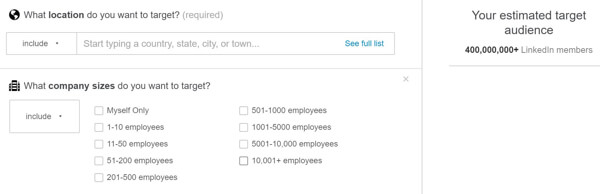
As you apply filters to narrow that audience to match your ideal prospect, the size of the target audience will naturally decrease. Which is to be expected.
But, if you filter the audience to show only companies with 50 or fewer employees (as illustrated in the second screenshot below), you can see that the estimated target audience shrinks down to 31 million LinkedIn members.
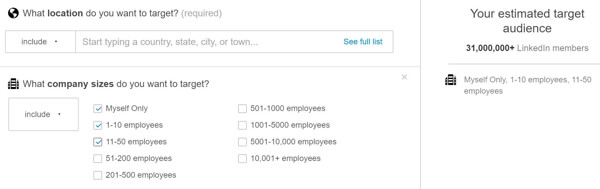
That's only 7.8% of the original 440 million possible target audience, which is really cutting a lot of your potentially golden audience.
But if you exclude all known company sizes, you'll see an estimated target audience of 300 million.

Tired of Guessing Which AI Moves Matter?
New AI tools and strategies launch every week — and figuring out which ones matter takes hours you don't have.The AI Business Society filters the noise for you, with expert-led training you can put to work the same day — plus a community of marketers sharing what's actually working.
I'M READY FOR REAL AI RESULTS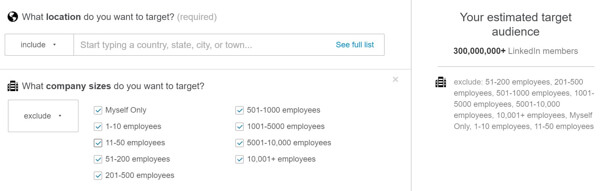
That means that only approximately 25% of all LinkedIn members have a company size associated with their profiles.
While this looks bad, it's actually a really good thing, because you can get significant discounts on ad clicks if you pursue audiences that others don't bother with or don't know how to target. Here's how to get to those LinkedIn users.
Go Deeper Than an Article Can Take You
Join thousands of small-business marketers at Social Media Marketing World — three days of AI, social media, and marketing strategy taught by world-class experts. April 1–3, 2027 in Anaheim.
Every session is pitch-free and built around tactics you can use yourself, no big team required. Your All-Access ticket includes an extra day of workshops, full access to AI Business World, and recordings of everything.
GET MY ALL-ACCESS TICKET — SAVE $780Use Exclusions Instead of Inclusions to Filter by LinkedIn Company Size
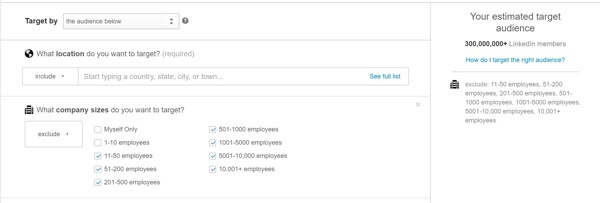
Instead of building a target audience by including only the company sizes you want to reach, you'll want to build your target audience by excluding all the company sizes you don't want to reach.
For example, if you want to reach companies with 50 or fewer employees, you can use the broad exclusions to filter out companies with 51 or more employees. By using the exclude option in your filtering, you now have an audience of 300 million potential target members; this audience is roughly 10 times larger than the audience of 31 million you get by using the include filter.
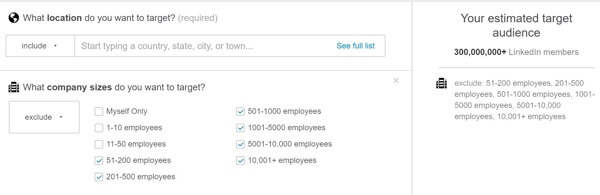
If you want to reach companies with 10 employees or fewer, you can try using the broad exclusions to filter out companies with 11 or more employees. Currently, the estimated target audience size remains the same for me, as when I run the targeting to exclude companies with 51 or more employees.
Want more like this? Explore our LinkedIn for Business guide!
.
Conclusion
Company Size filters are extremely valuable, and many marketers use them as a smart way to generate ideal leads. Still, the targeting relies on humans to make sure the relevant data the filters need is entered into LinkedIn in the first place.
If your ideal audience is made up of small- and medium-size business prospects, and you're marketing to them using LinkedIn advertising, this targeting trick will get you access to 10 times more potential prospects, and at lower levels of competition than you faced before being able to reach them.
What do you think? Have you tried this targeting technique? What effect did it have on your audience sizes? Please share your thoughts and experiences in the comments below.
Where Do You Actually Stand With AI?
Most marketers use AI, but they don't know what's holding them back from real results.
Our 3-minute quiz pinpoints the one gap keeping you stuck — and gives you the exact next step to fix it.
GET MY RESULTS