3 New Studies Show Value of Social Media & Businesses Slow Response
There are some interesting studies surfacing lately in the world of social media. Here’s a summary of three recent research findings covering the benefits of social media marketing, how forums help brands and how businesses are employing social media marketing.
#1: 50% of Small Businesses Say Lead Generation is Biggest Benefit of Social Networking
According to the “Small Business Marketing Forecast 2010” from Ad-ology, lead generation is the biggest benefit of social networking for U.S. small businesses.
Here’s the breakdown of respondents’ top benefits of social networking:
- 50%: Generating leads
- 45%: Keeping up with the industry
- 44%: Monitoring online conversation
- 38%: Finding vendors/suppliers
This chart shows the level at which the respondents found each social networking benefit useful.
Here’s a surprising statistic: While 67% agreed that social media is a good way to increase business, 39% of those surveyed said they did not plan to use social networking in their marketing plan in 2010. This number is likely tied to the finding that 31% reported that their customers do not use social media, 29% stated they do not have enough time to devote to it and 21% said they do not know enough about social media.
Although more businesses are beginning to adopt social media strategies into their overall marketing plans, this report suggests businesses still have a long way to go before social media is fully integrated into marketing efforts.
#2: Online Forum Users Are Enthusiastic Brand Advocates
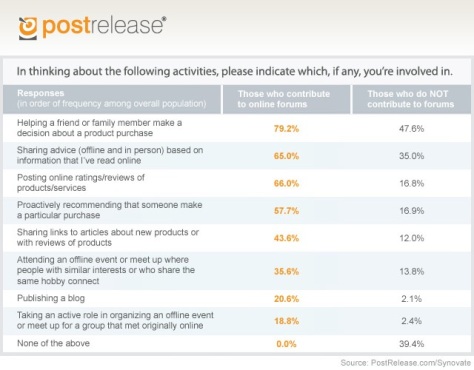
According to a recent survey published by PostRelease, people who actively contribute to online forums are overwhelmingly more engaged in “influential” activities – both online and offline – than people who don’t use forums.
What’s most interesting about these findings is that a forum contributor’s influence far extends past the walls of the forum. Here are some statistics:
- 79.2% of forum contributors help a friend or family member make a decision about a product purchase – compared with 47.6% of non-contributors and 53.8% overall.
- 65% of forum contributors share advice (offline and in person) based on information that they’ve read online – compared with 35% of non-contributors and 40.8% overall.
- 57.7% of forum contributors proactively recommend someone make a particular purchase – compared with 16.9% of non-contributors and 24.9% overall.
There’s also an interesting correlation between forum users and blogging. The study found that those who contribute to online forums are 10 times more likely than non-contributors to also publish a blog, and are 9 times more likely to take an active role in organizing an offline event or meeting for a group that originally met online.
For marketers who are looking to connect with the key influencers in their niche, the findings suggest that online forums are a smart place to start; however, marketers should proceed with caution. Justin Choi, founder and president of PostRelease, writes, “Online forums are great places to find enthusiastic consumers and influential brand advocates. The people in forums are often discussing specific products, sharing advice and asking each other for recommendations. For marketers, participating in that discussion is not quite as simple as jumping into a forum conversation – forums have rules about that. But there are tools for connecting in a way that’s transparent and relevant.”

Here's a snapshot of the behaviors and habits of people who contribute to forums versus the non-contributors.
#3: Only 47% of Companies Experimenting With Social Media
A study by Gartner predicts that by the end of 2010, more than 60% of Fortune 1000 companies will manage an online community. However, another study by ComBlu brings Gartner’s findings into question.
ComBlu’s study, The State of Online Branded Communities, shows how most companies do not understand how to engage within online communities and have no real idea of what their customers want on these sites. Furthermore, most companies are unaware that people interact on these sites in different ways, so many companies are merely pushing data with little or no interaction.
The report reveals that when companies do get people to join their communities, their lack of engagement is extremely obvious to the sophisticated user.
“Instead of engaging the visitor, the brand drives them away because they offer little of value. Consumers today are sophisticated users of social tools and seek out communities to learn, share and interact. If these elements are missing, or there is no obvious organizing structure that fulfills specific needs, the ‘faux’ community will be quickly abandoned,” stated the report.
Here are some interesting findings related to brands and their online community activity (or lack thereof):

- 47% of brands are still in the experimental phase, meaning they “exhibit lots of social activity with little connection or integration with each other.”
- 24% are community ghost towns, meaning there is no engagement and very few members with no return visitors.
- 20% show a cohesive strategy and typically had robust engagement tools and multiple activities with an active participation from their community.
- 9% show community overload with multiple messages to the same audience, most likely causing confusion and diluting the message.
Perhaps even more important, the study points out that some of the most effective online community best practices were used the least. Of the 135 communities they examined, only:
- 44 have a community manager. A community manager acts as the face of the community. Without one, there is no cohesive bond between the community sponsors and its members.
- 44 allow social networking. This practice allows community members to connect with each other and find shared interests, thus promoting further connection.
- 35 offer social bookmarking. This best practice gives community members a tool to personalize and aggregate their online experience at the brand’s destination site.
What do you think about these study findings? As always, we want to hear from you. Have you had similar results that support the data above or does your social media experience contradict the findings? Let us know your thoughts in the comment box below!

Amy Porterfield is a social media strategy consultant. Her passion is helping companies, authors and speakers create raving fans using social media and online marketing. Other posts by Amy Porterfield »


34 Comments
Unfortunately, some businesses/organizations are a little slow in truly realizing the value of social media marketing. There's definitely a learning curve there that I think some are afraid to commit to but this blog post helps to show that it could be worth it. There are brand advocates and people out there ready and willing to learn, interact, and engage with a company or brand and whoever is there to provide that to them first I think will perform best in the long-run. I am just now figuring out the best way to position my company's presence in social media and it's true that creating a genuine and engaging community is one of the best practices! It's all a process that you learn as you go.
As social media tools are integrated with traditional media, Fortune 1000 companies will have a better understanding of how to incorporate social media as an integral part of their marketing strategy. Education must focus on the best practices that optimize results – that's what companies want regardless of the marketing strategy they employ.
Those are powerful statistics. Only 47% of businesses experimenting with social media. I would presume that there is a lack of understanding on how to benefit from social media. Paul Dunay, global managing director-services and social marketing at Avaya says: “2010 is the year social media leaves the marketing group. If you have someone who really knows the social media landscape, they can galvanize the company around the customer.” I believe there are many organizations that could benefit from a boost from proper social media integration.
It is really interessting to get a look at the statistics concerning small businesses in the US. I am wondering how the industry in Europe is judging the added value of social media activities. Speaking from my own experience many businesspeople are not familar with the tools, they are afraid of wasting their time and it is hard to convince them to look over and above the old type of marketing.
As a sole practitioner recruiter, I am anxious to use social networking but am very confused as to really use to use it both to gain lead for positions to work on and also to find candidates.
[...] 4) Show corporate management stats on issues where competitors used social media & they did not. It’s a very clear way to demonstrate value. [...]
Interesting set of survey findings!
Some of the apparent contradictions in the findings suggest the continuing need to be cautious with generalizations regarding the true marketing role of social media networking — at this point in time. Individual preferences are still evolving and results are yet to attain the status of “universal” trends. As a solo gig, I'm completely sold on the marketing and professional benefits of blogging. I'm getting encouraging links with Twitter, but I'm stayng away from Facebook.
[...] Read More « 5 Elements of a Successful Facebook Fan Page [...]
Nice informative post. Social media has really been powerful. There are many people who have been using it, might be a celebrity, a businessman a politician or even an ordinary person. It has already made a mark on every individual.
May be the graph showing the downfall but social media marketing ensures business owners create awareness of the product to the wide range and more target audiences its shows where to start marketing
http://www.wowzzy.com
Frankly I'm surprised that the report shows 20% have a strategy. Most of the conversations I've had with clients or business owners using SM show that their “strategy” is to use SM. They have no plan, target segmentation or tracking action. I would certainly agree with the ghost town figures. The 9% in an overload phase actually seems low.
I understand so well that many companies have a will to do social media, but they don't have a strategy. Businesses/organizations have sales people who make their income making deals, not chatting on the web, whereas a communication officer has most likely a very formal approach that prevents him from engaging in the bolts and nuts of social media.
What social media needs is proof of sales. What increase in cash flow will I get from going to facebook? Many people wants facts…
Per the report on characteristics of people who participate in online forums, please give me an example of some of the more popular forums or an example of such.
[...] I recently read an interesting stat that said 31% of small businesses did not believe that their customers use social media. This stat really made me think about these business owners and how much they know about their business. [...]
Perhaps we can share a little of what we discovered having managed several Fortune 500 Social Media campaigns on Facebook:
1. Folks who get it – These marketers are not rare. Just that convincing management takes time since most executives were trained in a traditional marketing sense. To make matters worse, there is a lot of politics to figure out whose role it is – Marketing Communications (Ads) or Corporate Communications (PR)?
2. Folks who don't get it – These marketers are unfortunately still in the majority, but not for long. Imagine suddenly having to own direct relationships with customers when not too far in the past, you would easily have relied on talking to just a few media owners or agencies to manage your customers on your brands' behalf! Of course, there are instances when marketers believe that Social Media marketing is free! This sort of statement is amounting to saying that the cheapest creative work is with the free version of MS Paint….
Education is a necessary ready the industry as a whole towards including Social Media as part of the marketing mix. The unknown can be rather confusing and frightening, but the excitement usually far outweighs any negative thoughts!
If you are interested in how we are educating our clients and partners on marketing on Facebook, remember to check out our eBook – Building Facebook Fandom (http://bg/sg/fandom). The only cost is your time to read it!
3. Folks
http://bg/sg/fandom link did not work
Brenna-you have the right idea for sure. It is tough that so many companies still do not see the value of social media marketing. But from all that I have read in the last few months, more and more companies are getting on board. I think the focus will soon turn toward how to really engage, vs. just blast, on these platforms. For companies just entering this space, that concept is sometimes hard to grasp. Thanks for stopping by!
So true! I think that is why the case studies that are we seeing more and more of are extremely helpful to the new companies that are just ramping up with their social media activity.
I agree. “Integrations” is the proper word here. Some companies seem to think it has to be all or nothing with social media marketing and the overwhelm of that thought paralyzes them. But they jump into this space ill-prepared with no real strategy. That is so dangerous for a brand. But when properly integrated with an existing marketing plan, the success rate is so much higher. As social media matures and we see even more case studies that reflect best practices, the landscape will change. Thanks for sharing!
Rachel–why are you staying away from Facebook? My personal belief is that Fan Pages are a much better way to engage and create community vs. Twitter. I am curious to hear your thoughts!
Roger, I've had the same experience as you. When the SM strategy is “use it,” that's when we see no engagement, little understanding of building community and a lot of broadcasting of data with little conversations. I really think we will see a shift here as more businesses get educated, but the stats do seem a little low in regard to this topic. Thanks for your input!
It's tough because businesses do want the facts on how to monetize–but when companies rush and start thinking “How can I make money on Twitter?” it shows–it is blatantly obvious why they are in the space. I suggest to my clients to get their strategy together and make monetizing the activities at the bottom of the list in the initial stages–because without the solid engagement foundation, it all can fall flat fast.
Hi Amy.
I guess the simple (and honest) answer is time constraint. I have 3 business Blogs, Twitter, LinkedIn, and I try to participate in forums of interest. When I first looked into FB there just seemed to be a lot “socializing”, which didn't quite fit into my business plan. I need to focus on what works with my current marketing strategy. Who knows, I might look at FB again sometime.
[...] it’s a great re-read. But, what really made me want to review the book here was when I spotted this blog post [...]
Apologies. Here is the corrected link – http://bg.sg/fandom. Silly me…typo. Thanks Roger!
I share Amy's concern. I think perhaps FB Pages can be tweaked to be just a powerful. Quite frankly, the marketers we are working with seems to think Facebook is behaving like a combo of forums, twitter and everything else….sort of like a all-in-one platform. The great feature is that it is bite sized when it comes with communicating! No lengthy chatter. Forces us to get to the point!
Well, there are folks who dun get it, but there are those who got it, but got bogged down by intense politics – whose responsibility is it? Corp comms? Marcoms? The fight continues…
That's good to know — the all-in-one platform potential. Anything that works and saves time is certainly desirable!
[...] or offline—and family are trusted sources when making purchasing decisions. As mentioned in my previous article, a recent study from PostRelease showed how online forum users are enthusiastic brand advocates and [...]
[...] is quick to acknowledge the changes but their response is varied. In a recent survey of small business owners “67% agreed that social media is a good way to increase business, yet 39% did not plan to use [...]
yup, companies experimenting with social media and expected result is superb….
Social media can help you to reach your target audience without too much efforts and resources. If done properly you can get good amount of business lead.
Some systematic study may be required to generate some connection between nature of you your business and possible options in social media available.