by
by Curious which new LinkedIn features can help your brand reach entirely new audiences? Wondering how to stand out on LinkedIn when AI-generated content is flooding every feed?
In this article, you'll discover how collaborative posts and the creator marketplace work, how a new analytics metric reveals whether your content is breaking beyond your existing network, and how to use AI on LinkedIn without getting flagged.
#1: How LinkedIn Is Handling AI-Generated Content and What It Means for Marketers
LinkedIn has doubled down on reducing what the platform calls AI slop, low-quality content that appears to be generated by AI and lacks a clear perspective. Now, content flagged this way is less likely to be distributed beyond a person's immediate network, which directly undermines the goal most marketers have on the platform: reaching new people.
The irony isn't lost on anyone. LinkedIn was among the first platforms to build AI features directly into the compose box, encouraging users to enhance posts with AI. Now the platform is penalizing content that leans too heavily on those same tools. AJ Wilcox acknowledges the contradiction but sees the shift as a positive one. If every post on the platform reads like AI-generated filler, nobody stays. The feed becomes unusable, and LinkedIn loses its value as a professional network.
The distinction LinkedIn is drawing isn't between AI-assisted and human-written content. It's between content that communicates something of value and content that doesn't. AJ explains that sharing original experiences and genuine insights, especially insights so current that AI models haven't already absorbed them, is what separates useful content from slop. The goal isn't to avoid AI entirely. It's to be the brain behind what gets published.
Michael Stelzner describes his own approach to this balance. After training a Claude project on his writing voice, he initially used it to draft LinkedIn posts from scratch. Over time, he noticed the tells that both humans and algorithms can detect: formulaic phrasing, predictable structures, and a lack of genuine perspective. He shifted to writing entirely in his own voice first, then using AI as a consultant to identify weak spots and sharpen his hooks. The result is content that sounds like him rather than like it could have come from anyone.
The enforcement mechanism isn't purely algorithmic, though. LinkedIn's system flags content, but human behavior reinforces the signal. LinkedIn visibility has always been driven by engagement. Low-quality organic posts have always gotten low-quality reach; the AI crackdown simply formalizes what was already happening.
On the paid side, the dynamic is different. LinkedIn doesn't restrict the reach of ads based on whether AI created them. As long as an advertiser pays and stays within platform guidelines, the ad gets distribution. But AJ's clients see a clear pattern: ads that feel AI-generated or low-quality get less user engagement, which defeats the purpose of running them.
Pro Tip: LinkedIn has also introduced Brand Kit inside Campaign Manager, where advertisers can upload brand assets, including colors, fonts, and brand voice, to keep AI-generated ad copy and creative aligned with their guidelines. The platform now offers AI-powered image generation for ads as well, making it easier to produce ad creative within the LinkedIn ecosystem without external tools.
#2: LinkedIn Collaborative Posts and the Shift Toward Trust-Based Reach
In a landscape where anyone can spin up a professional-looking website and post five LinkedIn updates a day with AI, trust becomes the differentiator. Aligning a brand with people who already have credibility with an audience is one of the most effective ways to break through, and collaborative posts formalize that approach on the platform.
LinkedIn's new collaborative posts feature allows multiple profiles and company pages to publish and share a single post together. This isn't the same as tagging someone in a post, which can happen without their permission. Collaborative posts require explicit opt-in from each party, and every participant must approve the post before it goes live. When the post is live, all collaborators are visibly credited at the top.
AJ believes this feature will become table stakes. Company page posts on LinkedIn get minimal organic reach, as do reshares of those posts. Collaborative posts offer a way around both problems. Instead of asking employees to reshare a corporate announcement, a company can invite an employee to co-author a post that carries their name and reaches their network.
The opportunity extends beyond internal teams. Brands that find partners with tangentially related products or services, not direct competitors, can collaborate on content. Both company pages and individual thought leaders within those companies can appear on the post, extending reach across multiple audiences. And soon, pages and personal profiles will be able to share posts together, allowing a company to tag specific departments or individuals behind a product update.
How to Start Using Collaborative Posts on LinkedIn
The first step is identifying the people who already care about what the brand does and inviting them to collaborate on a shared topic. AJ recommends starting with people already in the brand's orbit: top fans, vocal commenters as well as current and past customers.
Go Deeper Than an Article Can Take You
Join thousands of small-business marketers at Social Media Marketing World — three days of AI, social media, and marketing strategy taught by world-class experts. April 1–3, 2027 in Anaheim.
Every session is pitch-free and built around tactics you can use yourself, no big team required. Your All-Access ticket includes an extra day of workshops, full access to AI Business World, and recordings of everything.
GET MY ALL-ACCESS TICKET — SAVE $800The pitch can be simple. Reach out about a topic both parties genuinely care about, and propose that each person post in their own voice, tagging the other. No money needs to change hands, and the value is mutual: both parties extend their thought leadership to a new audience.
Based on how similar features have worked on other platforms, particularly Instagram, collaborative posts are likely to reach both collaborators' audiences and then expand to similar audiences if the content generates strong engagement. AJ had significant success with Instagram's version of this feature and expects LinkedIn's implementation to follow a similar pattern.
Pro Tip: If a post has two names at the top, especially a company name, it may immediately feel less organic to readers scrolling their feeds. AJ recommends writing collaboratively produced content in a conversational tone, leading with personal experience and perspective rather than corporate messaging.
#3: Optimizing Profiles for LinkedIn's AI-Powered People Search
LinkedIn has expanded its AI-powered people search to all US users, removing the premium-only restriction.
The search now uses natural language, so users can describe who they're looking for by intent rather than plugging in exact keywords. Verification badges appear in search results acting as an added trust signal, and AI-generated profile summaries explain why a person is relevant, highlighting shared connections and experiences.

Tired of Guessing Which AI Moves Matter?
New AI tools and strategies launch every week — and figuring out which ones matter takes hours you don't have.The AI Business Society filters the noise for you, with expert-led training you can put to work the same day — plus a community of marketers sharing what's actually working.
I'M READY FOR REAL AI RESULTS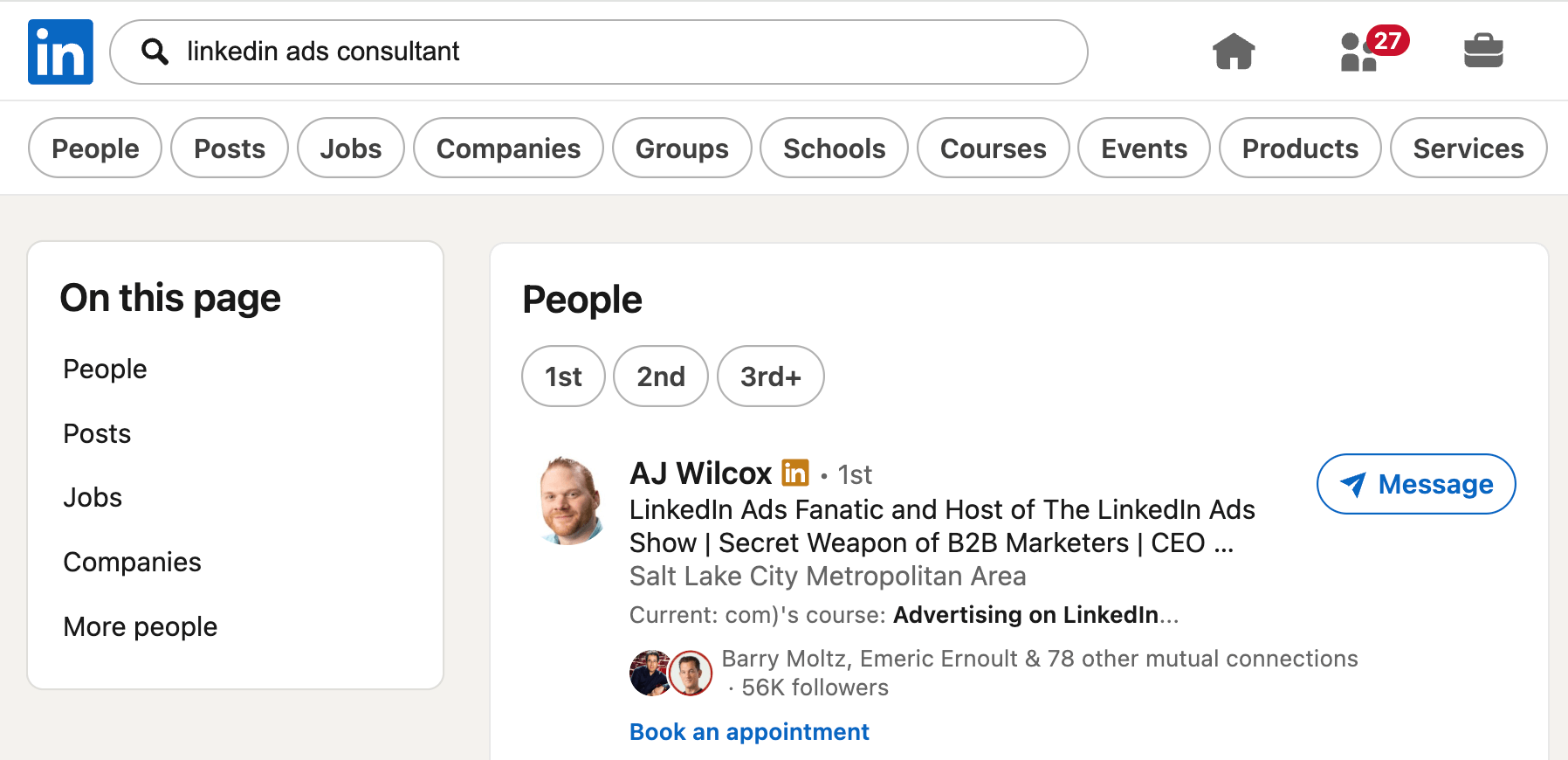
AJ's take is that profile visibility is becoming the new SEO, and any way to decorate a profile and stand out in search results is worth pursuing.
AJ suggests treating profile optimization as a strategic exercise. Rather than stuffing a profile with keywords in the format HR departments traditionally recommend, focus on expressing professional expertise and goals in clear, natural language that AI can parse and present accurately. AJ recommends using a personal profile as a test case: searching for it, reviewing how the AI summarizes it, and refining the profile until the summary matches the desired positioning.
#4: The Creator Marketplace and How Thought Leader Ads Amplify Reach
LinkedIn has launched a creator marketplace within Campaign Manager where brands can find, evaluate, and partner with creators based on their expertise, audience, and content performance.
The marketplace is designed to make it easier for brands to launch thought leader ads, which are LinkedIn ad units that promote an individual's organic post to a targeted audience with paid dollars behind it. Thought leader ads are the cheapest and most effective ad format on LinkedIn, generating high reach and engagement at low cost.
The creator marketplace solves a common bottleneck: marketers who can't convince their CEO to write posts or record videos now have access to third-party voices who are already talking about the brand. The marketplace surfaces creators who have mentioned a brand in their posts, making it easy to identify organic advocates and request permission to sponsor their content.
When a brand sponsors a creator's post as a thought leader ad, the brand controls the audience targeting. Because the post already has social proof from its organic run, the sponsored version is more effective than a cold ad.
How Creators Can Attract Brand Partnerships Through LinkedIn
For creators looking to get noticed by brands through the marketplace, the path is straightforward: mention the brand in a post. That's enough to surface in the marketplace when the brand's marketing team checks.
AJ notes that tagging the company page may not work, since many companies don't closely monitor their page notifications. Tagging specific individuals at the company, someone in partnerships or marketing, is far more likely to get attention since personal notifications are checked more frequently.
A more ambitious approach involves creating public content that demonstrates expertise relevant to a specific brand. Post a detailed analysis, review, or strategic breakdown that tags the brand and key people within it. That type of content does double duty: it reaches the creator's own audience while signaling competence to the target brand. If the post generates enough engagement, the brand's people are likely to see it through their networks, whether or not they were tagged.
Creators can also strategically amplify their own thought-leader ad posts. Michael described a creator who, when a brand sponsors a post with her, tags her own business page and uses part of the budget to boost her personal profile post through the ads platform.
AJ confirmed the logic of that approach, explaining that organic posts typically exhaust their reach within the first day or two, but sponsoring a post can generate impressions far beyond the creator's follower count. For creators pitching brands, being able to guarantee a specific impression count, say 100,000, adds significant value to the partnership, since 100,000 impressions are inexpensive through LinkedIn's ads platform.
AJ shared that it's even possible to sponsor a post and target it exclusively to employees at a specific company. The minimum audience size is 300 people, so this works best with enterprise-level companies. But the cost is minimal, around $80 CPMs on the high end, and for an audience of a few hundred people, the total spend is negligible compared to the potential value of landing a partnership or getting hired.
Pro Tip: Some creators charge for turning their posts into thought leader ads, but it's not the norm. When a brand sponsors a thought-leader ad, the creator's profile gains significantly more visibility, which is often a sufficient value exchange. AJ sees most of his clients lead with this approach: the brand puts dollars behind the creator's profile to get it seen by more people. For many creators, that exposure is worth more than a flat fee.
#5: Using the Out-of-Network Reach Metric to Guide LinkedIn Content Strategy
LinkedIn has introduced a new post analytics metric that shows the percentage of impressions coming from in-network versus out-of-network audiences. In-network measures impressions from existing followers and their connections. Out-of-network measures impressions from people who don't follow or connect with the poster, reached through algorithmic recommendations, reshares, or search.
AJ sees this as a strong strategic move by LinkedIn. Previously, post analytics showed total views, reactions, and comments, which don't tell a creator much about whether are were actually reaching new people. Seeing that 90% of a post's views came from outside the network changes the calculation entirely. It gives smaller accounts evidence that posting is worth the effort, even if their follower count is modest.
For content strategy, the metric provides a feedback loop. AJ recommends tracking which topics consistently reach beyond the existing network and which stay contained within it. Over time, you’ll see certain subjects or formats travel further than others. The optimization isn't about changing how content is written but about understanding which topics resonate with audiences the poster hasn't reached yet, then doubling down on that content.
AJ Wilcox is the founder and CEO of B2Linked, a LinkedIn ads agency, and the host of The LinkedIn Ads Show podcast. Connect with AJ on LinkedIn.
Other Notes From This Episode
- Connect with Michael Stelzner @Stelzner on Instagram and @Mike_Stelzner on X.
- Connect with Jerry Potter on LinkedIn and YouTube.
- Watch this interview and other exclusive content from Social Media Examiner on YouTube.
Listen to the Podcast Now
This article is sourced from the Social Media Marketing Podcast, a top marketing podcast. Listen or subscribe below.
Where to subscribe: Apple Podcasts | Spotify | YouTube Music | YouTube | Amazon Music | RSS
✋🏽 If you enjoyed this episode of the Social Media Marketing podcast, please head over to Apple Podcasts, leave a rating, write a review, and subscribe.
Stay Up-to-Date: Get New Marketing Articles Delivered to You!
Don't miss out on upcoming social media marketing insights and strategies! Sign up to receive notifications when we publish new articles on Social Media Examiner. Our expertly crafted content will help you stay ahead of the curve and drive results for your business. Click the link below to sign up now and receive our annual report!

Where Do You Actually Stand With AI?
Most marketers use AI, but they don't know what's holding them back from real results.
Our 3-minute quiz pinpoints the one gap keeping you stuck — and gives you the exact next step to fix it.
GET MY RESULTS