by
by Are you overwhelmed by the endless tasks that drain your productivity? Wondering how to break free from the time-consuming, busy work that keeps you from focusing on what truly matters?
In this article, you'll discover how to leverage ChatGPT as your ultimate productivity partner and regain precious hours in your workday through strategic AI assistance.

Why AI-Powered Productivity With Generative AI Tools Matters More Than Ever for Business Owners
Every marketer and entrepreneur faces the same fundamental challenge: too many tasks and not enough time. The digital age has brought unprecedented opportunities, but it has also created an overwhelming array of responsibilities that can quickly consume your entire day.
Traditional productivity tools can often compound the problem rather than solve it. Cary Weston, host of the ChatGPT Experiment podcast and veteran agency owner, explains that the revolutionary difference with ChatGPT lies in its fundamental nature. Unlike conventional software that requires mastering complex features and functions, ChatGPT is an AI model that operates as a productivity partner rather than just another tool you have to learn. From day one, without any technical mastery required, it can immediately enhance your workflow and decision-making process.
ChatGPT and other tools like it aren’t software. You're not learning how to use features and functions of software. “It's really a productivity partner,” Weston emphasizes. This distinction is crucial because it means you can start seeing immediate benefits without the typical learning curve associated with new technology.
When you eliminate the anxiety of starting from a blank page, reduce time spent on repetitive busy work, and gain access to instant brainstorming and problem-solving support, you create space for the high-value activities that grow your business.
Most work projects naturally break down into three distinct phases.
The first phase is ideation and planning. It encompasses all the brainstorming, organizing, and strategic thinking that happens before you begin creating anything. It's the phase where you determine what you're doing, why you're doing it, and how you'll approach the task. While this phase is crucial for success, it often involves wrestling with blank pages.
The third phase is the perfection and polish stage. Here, you apply your expertise, insight, and unique perspective to refine and enhance the work. It's where you add your voice, make strategic adjustments, and ensure the final product reflects your standards and objectives. This phase should receive most of your attention because it's where your unique value shines through.
The problematic middle phase is what Weston calls the busy middle. This is where most people spend most of their mental bandwidth and time. It's the grinding work of transforming your ideas into a first draft or initial version. Unfortunately, this phase often exhausts people to the point where they don't have enough energy left for the crucial perfection phase.
ChatGPT excels at condensing this busy middle phase, allowing you to spend more time on ideation and significantly more time applying your expertise in the perfection phase. Instead of getting bogged down in the mechanics of creation, you can focus on the strategic and creative elements that require your unique perspective and experience.
The most intimidating aspect of ChatGPT for many people is knowing how to begin.
One of the biggest obstacles professionals face when approaching ChatGPT is the intimidating nature of artificial intelligence terminology. The technical language and programming associations can create unnecessary anxiety that prevents people from exploring the tool's capabilities.
Weston addresses this by reframing ChatGPT not as artificial intelligence but as an outstanding intern. This mental shift transforms how you interact with the tool and removes technological barriers that might inhibit natural communication.

Which AI Moves Actually Matter?
That's what every marketer is wrestling with now. New AI strategies, new tools, new takes every week — but no clarity. Most marketers and business owners are trying to figure out AI alone.The AI Business Society is your trusted guide. Get expert-led training you can put to work immediately. Plus a community of marketers sharing what's actually working.
I'M READY FOR REAL AI RESULTSPicture ChatGPT as someone sitting next to your desk, available twenty-four hours a day, with impressive capabilities but requiring your guidance and direction. This intern is dedicated to helping you and possesses extensive knowledge, but needs context and clear instructions to perform effectively.
When you approach ChatGPT with this mindset, your interactions become more natural and productive. You wouldn't expect a human intern to read your mind or understand complex requirements without explanation. Similarly, ChatGPT requires background information, context, and clear communication to deliver useful results.
The first step in working with your AI intern is simple: introduce yourself and ask for help. Open ChatGPT, provide basic information about who you are, what you do, and your company or role, and then directly ask how it can assist you. This straightforward approach often surprises people with the quality and relevance of the response.
For example, you might say:

This initial interaction serves two purposes. First, it gives ChatGPT essential context about your professional situation. Second, it establishes a conversational tone that encourages ongoing dialog rather than one-sided command-giving.
#1: The Amazing Intern Approach to Build and Train AI Models
This framework provides a practical structure for getting the most out of ChatGPT while maintaining realistic expectations.
Like any new team member, your AI assistant needs proper onboarding, clear instructions, and ongoing feedback to perform optimally.
Start by identifying one repetitive task that consumes significant time in your regular workflow. This might be writing proposals, creating social media content, drafting emails, or preparing reports.
Once you've identified the task, approach ChatGPT with the same level of detail you would provide to a human assistant. Explain the context: what you're trying to accomplish, who the audience is, why this task matters, and what success looks like. Don't assume that ChatGPT will intuitively understand your goals or requirements.
The conversation should unfold naturally. After explaining what you need, ask ChatGPT what additional information it requires to do its best work. This question alone will often reveal important details you hadn't considered sharing. ChatGPT might ask about your target audience, the tone you prefer, specific requirements or constraints, or examples of similar work you've done before.
Provide examples whenever possible. If you're asking for help with proposals, share a few successful proposals you've written. If you need assistance with social media content, provide examples of posts that have performed well. These examples help ChatGPT understand what you want to create, how you approach the task, and what quality standards you maintain.
Most importantly, remember that this is an iterative process. Your first interaction won't be perfect, and that's completely normal. Just as you would provide feedback and guidance to a human intern, you should continuously refine your instructions and expectations with ChatGPT based on the results you receive.
#2: Build Attribute Sets for AI Model Training to Get Consistent Results
To achieve consistent, high-quality results from ChatGPT over time, you need to develop what Weston calls attribute sets. These detailed collections of information help ChatGPT understand your unique requirements, style, and objectives across different projects.
Think of attribute sets as recipes for success that you can apply repeatedly. Just as a chef might have standardized recipes that ensure consistent results regardless of who's cooking, attribute sets provide ChatGPT with the essential ingredients it needs to produce work that matches your standards and style.
Weston recommends developing three core attribute sets as a solid foundation for most professional work.
Voice, Tone, and Style: This involves analyzing your existing writing to identify patterns in how you communicate, the vocabulary you use, sentence structure preferences, and the overall personality that comes through in your professional communication.
To develop this attribute set, gather ten examples of your best writing, whether blog articles, client communications, proposals, or other professional documents. Upload this data set to ChatGPT and ask it to analyze your voice, tone, and style. Request that it identify patterns in how you structure information, your language choices, and the personality characteristics that emerge from your writing.

The AI will provide a detailed analysis of your communication patterns, which you should save in an external document. This external storage is crucial because you should never rely on ChatGPT as a storage system for valuable information. The platform can sometimes become inconsistent, and you want to maintain control over your important attribute data.
Ideal Audience or Customer: This goes beyond basic demographics to include mindset, frustrations, goals, and emotional drivers. Think about who benefits most from your work, what challenges they face, what keeps them awake at night, and what outcomes they seek.
This audience attribute set might include information such as:
My ideal clients are small business owners with 2-10 employees who feel overwhelmed by marketing technology. They're successful in their core business but frustrated by inconsistent lead generation. They value practical advice over theoretical frameworks and need solutions they can implement without hiring additional staff. They're often skeptical of marketing promises because they've been burned by previous investments that didn't deliver results.
Company, Services, and Unique Value Proposition: This helps ChatGPT understand what you do, why you do it, and what sets you apart from alternatives. Include information about your business model, approach to solving client problems, and the specific outcomes you deliver.
These attribute sets typically expand to full pages of detailed information with paragraphs and bullet points. They're comprehensive guides that provide ChatGPT with deep context about your professional situation.
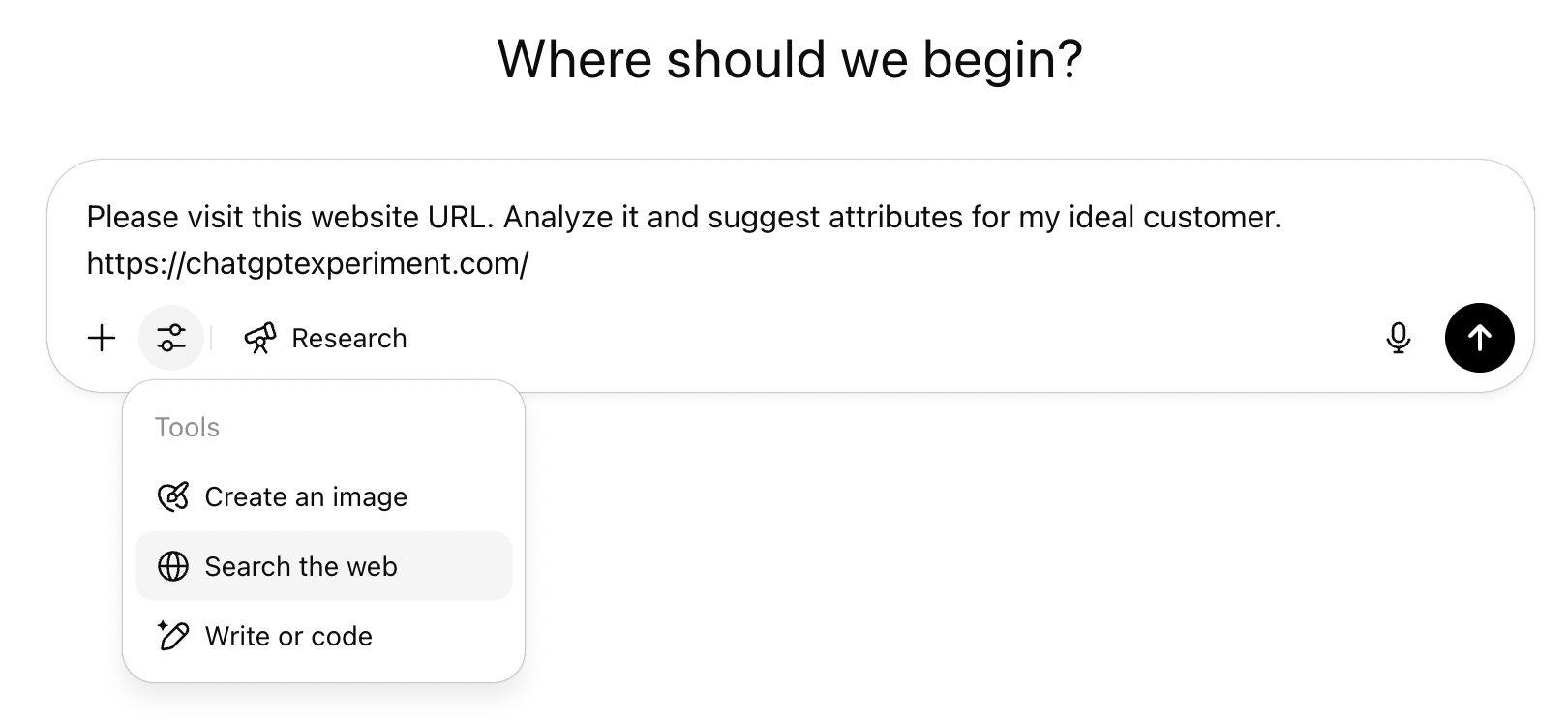
You can develop these attribute sets efficiently by leveraging ChatGPT itself. For example, provide your website URL and ask ChatGPT to analyze what it sees and suggest attributes for your ideal customer. The AI is typically ninety percent accurate in its initial assessment, providing an excellent starting point that you can refine based on your experience.
3 Days of World-Class Training—Zero Travel!

Couldn't make it to Social Media Marketing World and AI Business World this year? Get all of the great content at a fraction of the price with a Virtual ticket.
That’s full access to recordings of every keynote, workshop, and session—the ones people travel thousands of miles to see. Don't wait. Get your Virtual ticket and enjoy actionable content that you can watch anytime, anywhere.
#3: Technical Tips to Optimize Your ChatGPT Setup
As you become more sophisticated in your ChatGPT usage, several technical strategies can significantly enhance your results and workflow efficiency. These approaches help you get more consistent, higher-quality outputs while building a sustainable system for long-term success.
Use ChatGPT to Optimize ChatGPT
Rather than struggling to write perfect instructions or prompts on your own, leverage the AI's understanding of how it works best. When you've identified what you want to accomplish and gathered your examples or requirements, ask ChatGPT to help you create the instructions that will produce the best results.
“Use ChatTPT to create, polish, and improve upon the instructions that custom GPTs have,” Weston explains. AI tools have their own logic and preferences for how information should be structured and presented. By letting ChatGPT help design its own instructions, you're more likely to create prompts that work reliably and produce consistent results.
The process is iterative and conversational. Start with your basic requirements and ask ChatGPT to help you structure them into effective instructions. Then, use those instructions in practice and return them to ChatGPT with feedback about what worked well and what didn't. The AI can refine and improve the instructions based on real-world experience.
Never Accept the First Response as the Final Answer
ChatGPT tends to provide what Weston calls the equivalent of “raising your hand halfway.” It gives you a good starting point but often has much more depth and detail available. The simple phrase “tell me more” can unlock significantly richer and more useful responses.
“Anytime you ask ChatGPT to do something, it's going to give you that equivalent of raising your hand halfway. If you say, tell me more about a certain section, it's gonna go deep,” Weston notes. This means you should expect an ongoing conversation rather than receiving perfect results from a single prompt.
Follow Naming Conventions
When creating Custom GPTs or Projects, carefully consider naming conventions that will serve you long-term. Choose names that will make sense not just tomorrow but thirty days or even months from now. Consider how you'll locate and identify specific tools when you haven't used them recently or when you have multiple similar options.
The goal is to create names that an intern could understand and use effectively. This means being specific enough to convey the purpose while being descriptive enough to distinguish between similar tools. Generic names like “Writing Tool” won't help you choose between multiple writing-focused GPTs, while a specific name like “Blog Article Writing – Technical Audience” provides clear guidance.
Maintain External Backups
Always keep backups of important instructions, attribute sets, and other valuable information. While ChatGPT has become more reliable over time, it can still occasionally produce inconsistent results or experience technical issues. Keeping your copies of critical information protects your investment in training the AI and ensures you can quickly restore or recreate your setup if needed.
Pro Tip: Remember that ChatGPT never says no or claims it doesn't know something. It will always provide an answer, meaning you must maintain a healthy skepticism and verify important information from other sources. This characteristic makes it an excellent brainstorming partner but requires you to apply judgment and expertise to its suggestions.
Two Real-World Applications of Saving Time With AI
Transforming Proposal Creation
The most powerful way to understand how these concepts work in practice is through Weston's proposal creation system. This real-world example demonstrates how combining attribute sets with strategic ChatGPT use can transform a time-consuming task into an efficient, repeatable process.
The foundation of this system is thorough preparation. Weston first created a comprehensive model by feeding ChatGPT five or six successful proposals he had written over the years. Rather than just sharing the documents, he engaged ChatGPT in analyzing both the structure and the reasoning behind each section.
This deeper analysis helps ChatGPT understand the format of a good proposal and the strategic thinking that determines what information goes where and why each section exists.
For example, one section of Weston's proposals focuses on issues and problems you're dealing with. When training ChatGPT on this section, he doesn't just show the AI what information goes there—he explains the psychological and strategic reasons for including this content. By understanding that this section demonstrates empathy and establishes credibility by showing you truly comprehend the client's challenges, ChatGPT can better identify and organize relevant information from future client conversations.
The real magic happens when this preparation meets modern technology. Weston records his sales calls with prospective clients, creating transcripts that become raw material for proposal creation. “Transcripts are the new gold when it comes to AI,” he notes because they capture not just what was discussed but the actual language and concerns expressed by the potential client.
With both the proposal template and the conversation transcript, ChatGPT can extract relevant information and organize it according to the established structure. The AI knows to look for specific types of information—problems and frustrations, desired outcomes, timeline constraints, budget considerations—and place each piece in the appropriate section of the proposal.
The system creates multiple benefits beyond just time savings. Because the conversation is recorded, Weston can focus entirely on asking meaningful questions and building rapport rather than frantically taking notes. The resulting proposals use the client's language and address their specific concerns, making them far more compelling than generic templates. And because the heavy lifting is automated, Weston can invest more time in customizing and perfecting each proposal rather than rushing to meet deadlines.
This approach can be adapted to virtually any recurring business task. The key elements—developing templates, creating attribute sets, using transcripts or other raw materials, and focusing human effort on refinement rather than creation—apply whether you're writing marketing emails, creating training materials, developing project plans, or producing any other regular business content.
Enhancing Job Recruitment
One of the most practical applications of ChatGPT's capabilities is transforming the hiring process, particularly in creating compelling job descriptions that attract the right candidates.
Traditional job descriptions often fail because they're written from the company's perspective rather than the candidate's. They list requirements and responsibilities without considering what information a potential employee wants and needs to make a decision. This disconnect results in either too few qualified applicants or an overwhelming number of unsuitable candidates.
Weston's approach starts with your existing basic job description but transforms it through what he calls the empathetic position. Instead of simply posting requirements and responsibilities, you use ChatGPT to reimagine the job description from the perspective of your ideal candidate.
The process involves asking ChatGPT to consider the candidate's current situation and mindset. What are they looking for in their next opportunity? What questions do they have about potential employers? What concerns might prevent them from applying? What information would make them excited about the possibility of working with you?
This approach transforms a list of job requirements into a compelling narrative that speaks directly to qualified candidates. Instead of generic bullet points, you create content that addresses the candidate's perspective: their career goals, concerns about company culture, questions about growth opportunities, and desire to understand how their work will make a meaningful impact.
The resulting job description becomes much more than a list of duties. It tells a story about what it's like to work at your company, what kind of person thrives in the role, and what specific opportunities and challenges the position offers. It anticipates and answers the questions that candidates typically ask during interviews, making the hiring process more efficient.
This principle extends beyond just job descriptions. When you don't know the current best practices for where to post job listings or how to structure your hiring process, ChatGPT can serve as a research assistant and strategic advisor. By explaining your situation and asking for guidance, you can quickly get up to speed on current trends and proven approaches.
The search functionality in paid ChatGPT accounts becomes particularly valuable for these less frequent tasks. When you ask for recommendations about job posting platforms or hiring strategies, ChatGPT can search for current information and provide up-to-date resources rather than relying solely on its training data.
This hiring example demonstrates how ChatGPT's value extends far beyond routine tasks. Whether you're entering an unfamiliar area, haven't done something recently, or want to improve your approach to an occasional but important task, your AI assistant can help you research, strategize, and execute more effectively.
Cary Weston is the founder of The ChatGPT Experiment and host of The ChatGPT Experiment podcast, a show designed to help entrepreneurs and marketers understand how to benefit from ChatGPT. Follow him on LinkedIn.
Other Notes From This Episode
- Connect with Michael Stelzner @Stelzner on Facebook and @Mike_Stelzner on X.
- Watch this interview and other exclusive content from Social Media Examiner on YouTube.
Listen to the Podcast Now
This article is sourced from the AI Explored podcast. Listen or subscribe below.
Where to subscribe: Apple Podcasts | Spotify | YouTube Music | YouTube | Amazon Music | RSS
✋🏽 If you enjoyed this episode of the AI Explored podcast, please head over to Apple Podcasts, leave a rating, write a review, and subscribe.
Stay Up-to-Date: Get New Marketing Articles Delivered to You!
Don't miss out on upcoming social media marketing insights and strategies! Sign up to receive notifications when we publish new articles on Social Media Examiner. Our expertly crafted content will help you stay ahead of the curve and drive results for your business. Click the link below to sign up now and receive our annual report!
Curious About How to Use AI?
Our newest show, AI Explored, might be just what you're looking for. It's for marketers, creators, and entrepreneurs who want to understand how to use AI in their business.
It's hosted by Michael Stelzner and explores this exciting new frontier in easy-to-understand terms.
Pull up your favorite podcast app and search for AI Explored. Or click the button below for more information.