by
by Struggling to convert interested prospects into paying customers? Wondering why your perfectly logical marketing messages aren't driving the results you expect?
In this article, you'll discover how to apply behavioral science principles to improve your pricing strategy, enhance quality perception, and increase conversions.
Why Behavioral Science Matters for Marketers
If you work in marketing or advertising, you're fundamentally in the business of behavior change. Every campaign you create attempts to get people to switch from a competitor brand, pay more for your products, or buy more frequently. Each of these goals requires your audience to change its behavior.
Behavioral science is the experimentally based, robust study of what effectively influences people's behavior. This field doesn't examine what people claim influences their decisions, but rather what actually drives their actions.
For marketers, this distinction is critical because it reveals the gap between what consumers say they want and how they actually behave. By understanding and applying these principles, you can work with human nature rather than against it.
How Humans Actually Make Decisions
Before applying behavioral science to your marketing, you need to understand a fundamental truth about human decision-making. People tend not to make decisions in a deeply thoughtful, well-considered way.
Susan Fiske at Princeton describes people as cognitive misers. What she means is that humans try to ration deep, considered thought. For most decisions, people rely on quick, intuitive judgments rather than careful analysis. Her former colleague, Daniel Kahneman, puts it more colorfully when he says that thinking is to humans as swimming is to cats. We can do it, but we'd prefer not to.
From an evolutionary perspective, energy is a scarce resource. We have evolved to ration energy usage, and because thinking is energy-intensive and effortful, we don't deeply consider most problems. Instead, we make decisions in a snap, quick, intuitive way using what psychologists call heuristics, or what most people would simply call rules of thumb.
For marketers, these rules of thumb are particularly interesting because they're prone to biases. When discussing biases in this context, the term doesn't refer to negative prejudices. Instead, it describes the ways people deviate from purely logical purchasing behavior.
For example, social proof is a bias. Rather than weighing up a purchase decision based solely on their own preferences, people take a shortcut by thinking about what other people are doing. So, one of the most fail-safe ways of making your product more appealing is creating the impression that lots of other people are buying it.
If you know what these biases are, you can design your advertising, create your products, and structure your campaigns to align with how people actually make decisions. Three of the most powerful applications involve pricing psychology, quality perception, and conversion optimization.
#1: 3 Ways to Use Pricing Psychology In Your Marketing
Pricing represents one of the most direct applications of behavioral science because price shapes perception in ways that defy pure logic.
Raising Your Price vs. Discounting Your Price
A fascinating study by Baba Shiv at Stanford demonstrates how price creates expectations that become self-fulfilling. In his experiment, Shiv served people five different bottles of wine, each with a very prominent price label. The twist was that sometimes people drank a Merlot they thought came from a $5 bottle and rated it as tasting awful. Later, they thought they were drinking a different Merlot from a $45 bottle, but it was actually exactly the same liquid.
Even though the wine was physically identical, the ratings were 70% different. People rated the supposedly expensive wine 70% better. The adjectives they used to describe the wines changed completely based on price alone.
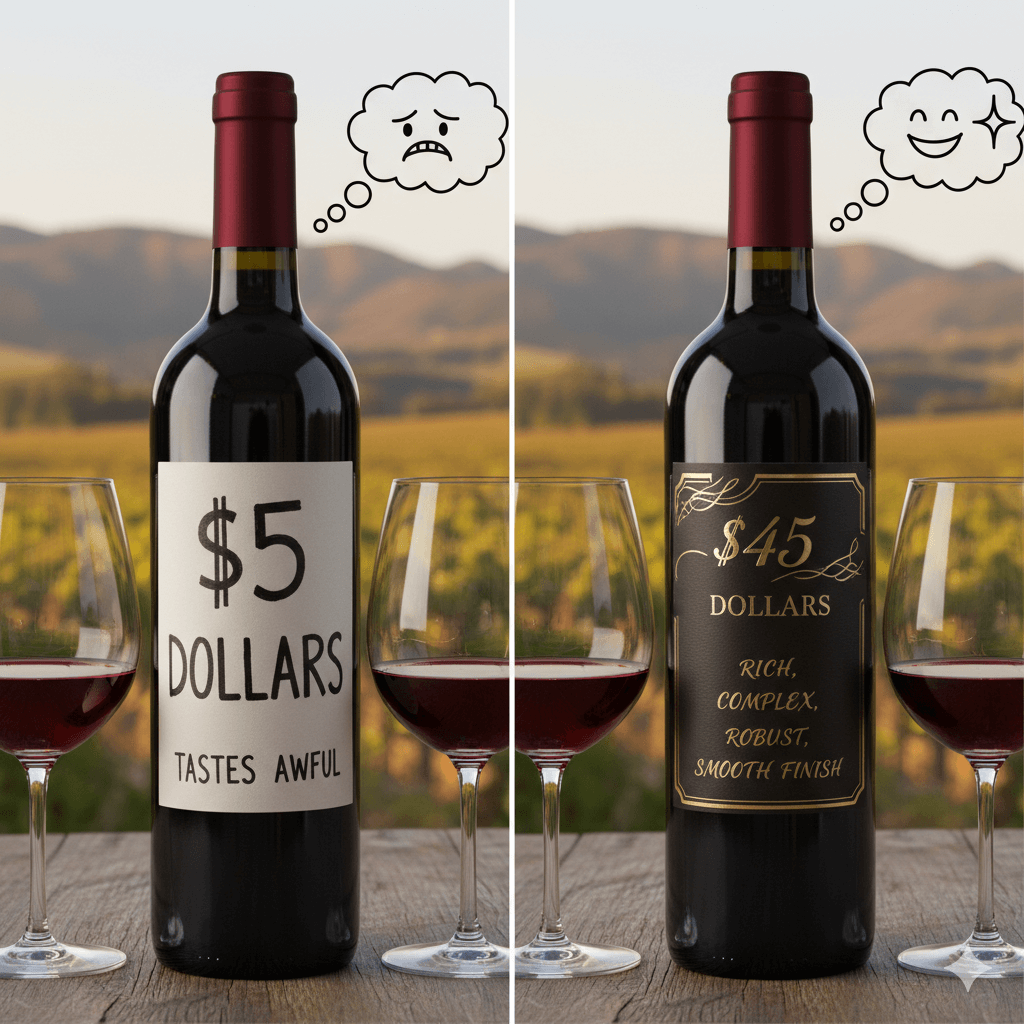
Shiv's argument is that we experience what we expect to experience, and one of the strongest factors setting expectations is price. People have a deeply ingrained rule of thumb that high price equals high quality. When you approach a situation with expectations, you actively look for confirming evidence.
Ready to Supercharge Your Marketing Strategy?
Get expert training and an unbeatable conference experience when you attend Social Media Marketing World—from your friends at Social Media Examiner.
Broaden your reach, skyrocket your engagement, and grow your sales. Become the marketing hero your company or clients need!
🔥 Save $510 on an All-Access ticket. Sale Ends Tuesday! 🔥
GET THE DETAILSIn Shiv's study, people expecting the wine to taste brilliant interpreted subjective feelings like tannin in the mouth as evidence that it had a proper body and had been aged appropriately. Those who thought it came from a $5 bottle attributed the same tannin to the wine being unrefined and cheap.
For brands, this opens up unexpected opportunities.
If you're not selling as much as you want, behavioral science suggests you should test increasing your price before you consider discounting it. You might be fortunate enough that the increased perception of quality leads to greater demand.
Making Your Price Feel Smaller
Once you've set your price, you need to make that price as appealing as possible. One powerful tactic is breaking the price into the smallest possible unit. This approach, known as the pennies a day effect, was first studied by John Gourville at Harvard back in 1998.
Gourville worked with charities and recruited people, randomizing them into different subgroups. Some people were asked if they would donate $365 a year, and the uptake was very low. Other people were asked if they would donate $1 a day for the rest of the year, and uptake was much higher.
This principle translates across categories.
In a 2015 replication study using car rentals, some people saw a car with the annual price of $1686. Other people saw the same car with the daily price of $4.57. When asked how good a value they thought the car was, only 11% of those who saw the annual price thought it was a good value. In contrast, 51% of those who saw the daily price thought it was a good value. The same product received nearly five times more favorable ratings simply by changing the unit of price.
The explanation relates to how people process information.
People are very good at understanding concrete things but very bad at understanding abstract ideas. Throughout most of human evolutionary history, we dealt with concrete dangers, not abstract concepts like compound interest. When you hear “a dollar a day,” what springs to mind is something concrete, like a cup of coffee. When you hear “$365 a year,” what comes to mind might be a mini vacation. What people don't do is multiply that dollar a day by three hundred sixty-five to create an equivalent comparison.
The entire market of services like Klarna and Afterpay is built on this foundation. When you visit a fashion retailer today, you might see an option to spend $100 on a sweater, or you might see “three payments of $35” with Klarna or Shop. People respond completely differently to $100 versus three lots of payments.

This approach also pushes later payments into the future, which taps into present bias. We're deeply influenced by pleasure or pain affecting us now or very soon, while we discount pleasure or pain that will affect us in the medium or long term. This explains why people go into debt, why credit card companies do so well, and why people don't save enough for retirement.
If you want people to respond as positively as possible to your price, don't say your software costs $365 a year. Say it costs $365 a year, which is the same as $1 a day. If you have multiple users, break it down per user. The key is to make the smallest possible number the most prominent in people's minds. For businesses offering subscriptions, you can still push annual plans while using the pennies a day effect to make them more appealing. You don't have to sacrifice business preferences to apply behavioral science.
Steering People Toward the Middle Option
Another powerful pricing principle is extremeness aversion, which describes how people tend to opt for the middle option when given three choices. Amos Tversky demonstrated this in 1992. He showed people two cameras. The basic camera cost $169, and a fancier camera with more features cost $239. When people chose which one to buy, there was an exact fifty-fifty split.
Tversky then recruited a completely fresh group of people and showed them the same two original cameras at the same prices with the same benefits. But he introduced a super premium camera at $469. A few people picked that super premium option, about 21%.
The fascinating change occurred in how people viewed the original two cameras. Previously, those two cameras were chosen at a one-to-one ratio. With the addition of the super premium option, that ratio shifted to one-to-three. The very basic camera dropped to 22% of sales, while the premium camera, now the middle option, jumped to 57% of sales.
What Tversky demonstrated is that people don't just pick based on the price, quality, and inherent attributes of a product. They are deeply influenced by what that product is surrounded by. The rule of thumb is that people don't want to go for the cheapest option because it might be low quality and they'll look mean. They also don't want the most expensive because it's probably over-engineered, overpriced, and they'll look like a show-off. People gravitate toward the middle.
The middle price of $239 is approached very differently depending on whether there are two options or three options. When compared only with the $169 camera, it looks $100 more expensive, and consumers think they're being wasteful. But when you've added the super premium $469 camera, people can now reframe that $239 cost as a $200 saving compared to the most expensive option.
If you have a monthly offering and an annual offering and you want people to pick the annual one, consider adding a two-year or four-year purchase option. Hardly anyone will pick it. Its role isn't to be picked. Its role is to reframe what the annual option looks like. Now the annual option doesn't look like much of an inconvenience or too long a time period because it's a year or two years less than the really long option.
Understanding pricing psychology allows you to present your offerings in ways that naturally guide customers toward decisions that benefit both them and your business. However, price is only one factor in purchase decisions. Customers also need to believe in your product's quality.
#2: 2 Ways to Establish Your Product as a Quality Option
While pricing sets expectations, your ability to convey quality determines whether those expectations are met. Behavioral science reveals two counterintuitive approaches to building quality perception.
Showcasing Your Development Investment
When people judge a product, they are influenced by how much effort they think went into creating that product. In a study for the book Hacking the Human Mind, researchers recruited two hundred eighty-two people and showed them a beautifully designed bottle of vodka from a fake brand called Black Sheep Vodka. Some people just saw the beautiful bottle and were asked how gorgeous they thought it was. 17% thought it was amazing.
Then another group of people saw exactly the same imagery, but they were told the designer had gone through one hundred forty-three iterations before getting to this design. The proportion of people who thought it was beautiful jumped to 23%. That's a 35% improvement in ratings for exactly the same product and exactly the same image, judged differently simply because people thought lots of effort had gone into it.
AI Is No Longer Optional for Marketers—Ready to Master It?

Join over a thousand forward-thinking marketers at AI Business World—a conference-in-a-conference at Social Media Marketing World.
Get two days of practical AI training where you'll discover:
✅ Systems that 3x your output—leaving time for strategy and creativity
✅ Proven strategies you can deploy right away—no guesswork, no wasted budget
Become the indispensable AI expert your company needs.
GET YOUR TICKETS—SAVE $150Andrea Morales at the University of Southern California, who first explored this concept, explains that judging quality is a complex question. People are cognitive misers looking for shortcuts. When faced with a complex question, people replace it with a simpler one that gives them an almost-as-good answer. If actually judging beauty or quality is the complex question, the simpler question becomes: how much effort do I think this designer invested? We use effort as a proxy for quality.
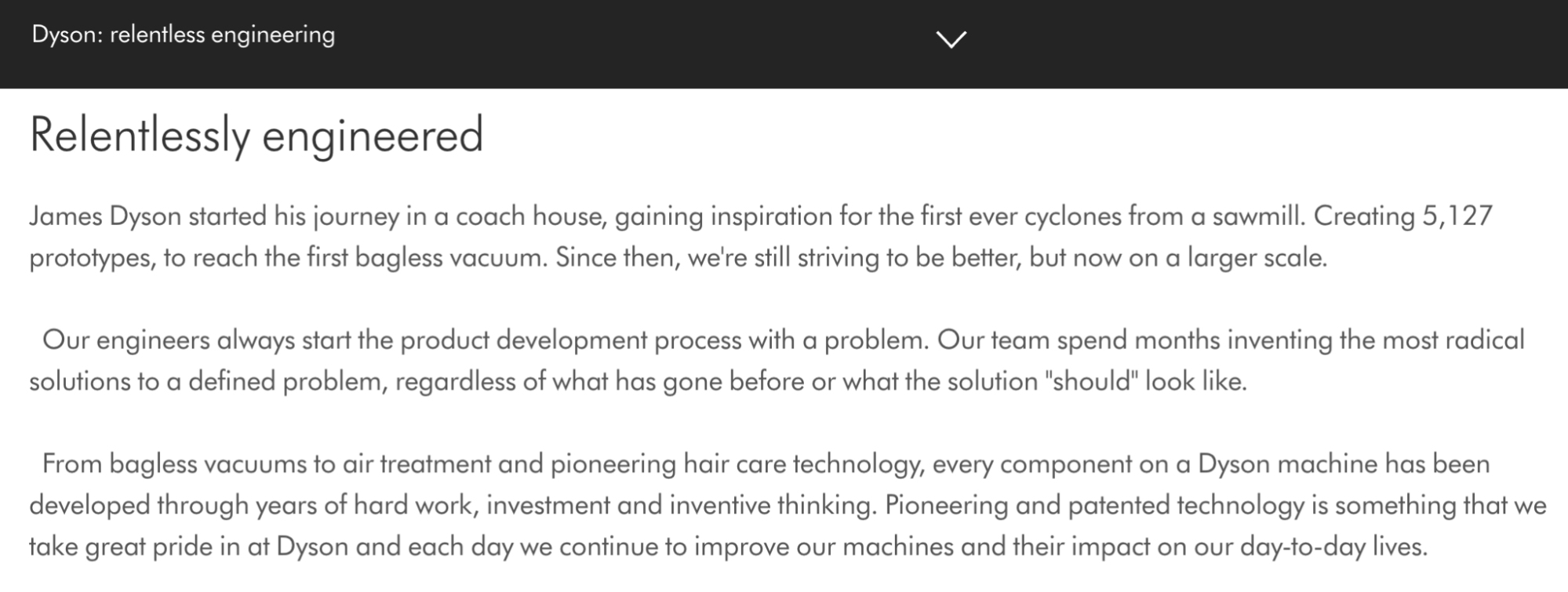
Dyson provides one of the best examples of applying this principle. This company created an entirely new market for premium vacuum cleaners priced around $300. Dyson is absolutely brilliant at constantly reiterating that they went through five thousand one hundred twenty-seven prototypes to get to the bagless vacuum. This figure appears in their original advertisements. Their website features extensive stories about this effort. The public relations team keeps reiterating this narrative. It's even the very first line of James Dyson's autobiography.
But Dyson doesn't rely solely on telling people about its effort. They also apply the labor illusion through physical design by being physically transparent. When you buy a Dyson vacuum, you can see into its inner workings. You can see the dust being sucked up. Most vacuums before Dyson had a beige opaque casing where you couldn't see what was going on inside. That transparency is a direct application of the labor illusion. Knowing the work going on makes us appreciate it more.
Research by Buell and Kim at Harvard supports this approach. They asked diners to rate the quality of their meals. Sometimes the diners could see into the open-plan kitchen and watch the chefs at work. Other times, they were sitting around the corner and couldn't see the chefs working. There was a significant difference. People who could see the kitchens rated their dishes higher, even though it was the same food from the same batch. Because the effort was made visible, it was rated higher.
The takeaway for businesses is that the service you create or the product you generate won't be judged just on its own merits. If you want to get the best possible reception, you need to let potential buyers know about the number of prototypes you went through, the years of experience you put into it, or the different designs you created. Whether through copywriting that stresses prototypes, physical design that reveals inner workings, or website features that showcase the creative process, be transparent about those efforts and you'll reap the rewards.
This isn't a recommendation to create fictitious stories. Most brands go to great lengths in their product development, but they have a mistaken belief that if the product is good enough, they don't need to tell people about the process. Study after study shows that isn't the case.
Highlighting Your Flaws
Another surprising quality principle involves the pratfall effect. This concept states that if you admit a flaw, you become more appealing. The best brands have taken this further by carefully identifying their core strength and then admitting a weakness that actually emphasizes that core strength.
An absolutely amazing campaign that demonstrates this started in Canada in 1986 for Buckley's cough syrup. At that time, this family-owned brand was not the biggest cough syrup in the market. It was tiny and inconsequential. Then they launched a new creative campaign with the tagline: “It tastes awful and it works.”
For the last thirty-nine years, Buckley's has gone to increasingly crude, creative, and funny ways of stressing how foul this cough syrup tastes. For example, one advertisement says the largest bottle they sell is two hundred milliliters, adding that anything larger would be cruel.
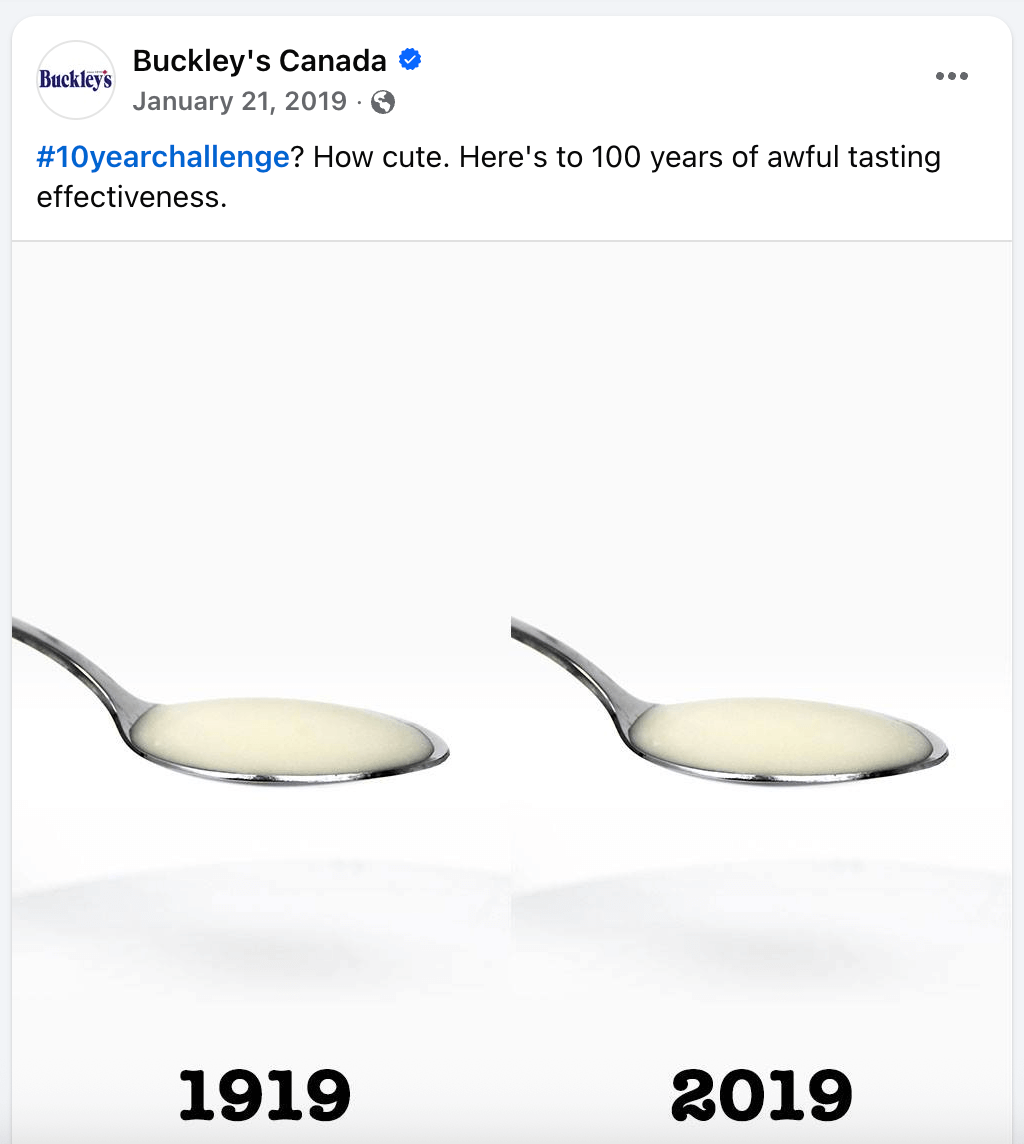
What makes this approach so effective is that they're not just admitting a flaw in their product. They're thinking strategically about what they really want to convey, which is efficacy and potency. Once they made that their badge of quality, they identified the weakness that serves as a mirror to their strength. When you tell people you taste foul, there's an automatic assumption that the trade-off is probably exceptional potency.
This is a massively underused tactic for boosting quality perceptions. Think about what your core strength is, and then consider what weakness you could admit that might emphasize that strength. Maybe you emphasize thoroughness by acknowledging you're slow, like Guinness does with “Good things come to those who wait.” Or maybe you emphasize exclusivity by acknowledging you're expensive. The key is finding the flaw that serves as evidence of your greatest strength.
Once you've optimized your pricing and established quality perception, the final challenge is converting interest into action. This is where many marketing efforts fall short, even when they've successfully generated motivation.
#3: How to Use Behavioral Triggers to Convert Consumer Intent into Customer Action
Even when you've successfully generated interest in your product and motivated potential customers, that motivation doesn't automatically convert to sales. This challenge is known as the intention-to-action gap, and understanding how to bridge it is crucial for improving conversions.
A classic 2002 study by Sarah Milne at the University of Bath demonstrates this gap perfectly. Milne was interested in how to get people to exercise, so she recruited two hundred forty-eight people and split them into three groups.
The first group came to a lab where they received a diary. Milne told them to fill in the diary over the next two weeks, writing down every time they exercised. When those people came back two weeks later, 35% of them had exercised at least once a week. That established the baseline.
Milne wanted to see how to boost this number, so her next group of people came into the lab, received the diary, and then watched a motivational film about why exercise is amazing, how it would change their lives, make them feel energetic, and increase their longevity.
People watched the film and reported feeling enthused and motivated to exercise. But when they came back two weeks later, the numbers had barely changed. Only 38% were exercising, up from 35%. Even though they said they were going to exercise and claimed they were really keen, their behavior hardly changed at all.
This demonstrates the intention to action gap. Motivation, according to Milne, is a necessary but not sufficient condition for behavior change. You need to add something else.
For the final group of people, Milne invited them to the lab, gave them the diary, played the motivational film, and then had those people make what a psychologist would call an implementation intention. She asked people to specify when, where, and with whom they were going to exercise. Someone might say they would exercise Tuesday mornings after dropping their daughter off at school.
Essentially, this creates a trigger to remind you to exercise. When that group came back, 91% of people had exercised at least once a week. That's a massive, massive difference.
Milne's explanation is that when you've associated a particular behavior with a specific moment, that moment acts as a catalyst to convert intention to action. When Tuesday morning arrives in the example, that moment triggers the associated behavior. Many people interested in behavior change do the hard work of generating motivation, but they fall down because they don't do the simpler task of attaching a behavior to a very clear time, place, or mood.
You can apply this principle commercially. Consider Snickers and their tagline, “You're not you when you're hungry.” They associate consumption with the feeling of being hangry. The advertisements don't talk about the product and how tasty it is. They associate consumption very clearly with a particular moment.
Other examples include Taco Tuesday, which associates the product with a specific day of the week. Champagne is strongly associated with celebration. In Britain, Kit Kat uses the line “Have a break, have a Kit Kat,” which Kit Kat wrote in 1947. All of these are associating a product with a very clear time or place.

Rather than simply asking people to take your vitamins twice a day, you should say “take them after breakfast” or “take them before dinner,” even if there's no pharmacological need for that specific timing. If you want people to fill in their timesheets at work, don't just say “Do it once a week.” Say “Do it on Friday morning.” You've got to give people that trigger moment. That's the key element.
By suggesting either subliminally, like Snickers does with “you're not yourself when you're hungry,” or explicitly, like suggesting people exercise after lunch when they've just eaten a lot of food, you can dramatically increase the likelihood they take the action you want them to take.
Motivation is a condition you need to set in place. You need to make your product desirable. But if you stop there, you've wasted all those efforts. You've wasted all those emails or television advertisements that generated that motivation. It's only when motivation is combined with a clear trigger, a clear time, place, or mood, that you get the best conversion from intention to action.
While the best examples of this principle come from the food category, you can apply this broadly. Even if you're selling luxury watches, you could associate purchase with a specific moment, such as “when you've been promoted, that's the time to buy a Rolex.” The experiments don't suggest any category limitation. The constraint is more often a lack of imagination among marketers who only look to their immediate competitors for inspiration.
Richard Shotton is the founder of Astroten, a consultancy that helps marketers use behavioral science to improve their results. He is the author of multiple books, including Hacking the Human Mind: The Behavioral Secrets Behind Seventeen of the World's Best Brands. His podcast is Behavioral Science for Brands. Follow him on LinkedIn and X.
Other Notes From This Episode
- Connect with Michael Stelzner @Stelzner on Instagram and @Mike_Stelzner on X.
- Watch this interview and other exclusive content from Social Media Examiner on YouTube.
Listen to the Podcast Now
This article is sourced from the Social Media Marketing Podcast, a top marketing podcast. Listen or subscribe below.
Where to subscribe: Apple Podcasts | Spotify | YouTube Music | YouTube | Amazon Music | RSS
✋🏽 If you enjoyed this episode of the Social Media Marketing podcast, please head over to Apple Podcasts, leave a rating, write a review, and subscribe.
Stay Up-to-Date: Get New Marketing Articles Delivered to You!
Don't miss out on upcoming social media marketing insights and strategies! Sign up to receive notifications when we publish new articles on Social Media Examiner. Our expertly crafted content will help you stay ahead of the curve and drive results for your business. Click the link below to sign up now and receive our annual report!

Want to Unlock AI Marketing Breakthroughs?
If you’re like most of us, you are trying to figure out how to use AI in your marketing. Here's the solution: The AI Business Society—from your friends at Social Media Examiner.The AI Business Society is the place to discover how to apply AI in your work. When you join, you'll boost your productivity, unlock your creativity, and make connections with other marketers on a similar journey.
I'M READY TO BECOME AN AI-POWERED MARKETER