by
by Is your LinkedIn reach falling? Do you know which signals LinkedIn's algorithm now uses to decide who actually sees your content?
In this article, you'll discover how LinkedIn's rebuilt feed algorithm changes who sees your content.
#1: Your Content Strategy and the New LinkedIn Feed Algorithm
LinkedIn has undergone one of the most significant overhauls in its history. The platform rebuilt its content algorithm from scratch, moving from five separate systems patched together into a single, unified AI-powered brain.
The most important shift is in how the feed distributes content. The old version showed you content primarily from people you already followed or connected with. The new system uses interest-based distribution to surface posts based on topics, not just account relationships. The system tracks what LinkedIn itself calls a user's “professional journey over time,” building an ongoing picture of interests rather than reacting only to the last thing someone clicked.
This mirrors the evolution already seen on YouTube, Facebook, and TikTok, where following someone no longer guarantees you see everything they publish.
The algorithm also now understands meaning, not just keywords. A post about reducing churn can now reach someone searching for customer retention, even if those exact words don't appear anywhere in your content.
The change means that specialists now have a meaningful advantage.
A series of related posts trains the algorithm to associate you or your brand with a specific topic, and then serves your content to the right audience more reliably over time. This compounding effect means specialists stand to gain more reach from the same amount of posting effort.
AJ Wilcox explains that a series of related posts trains the algorithm to associate you — or your brand — with a specific topic, and then serve your content to the right audience more reliably over time. This compounding effect means specialists stand to gain more reach from the same amount of posting effort.
Generalists face a different reality.
If you publish posts about AI, then your dog, then career fairs, then marketing strategy, the algorithm treats each post as a separate, unrelated signal rather than building cumulative authority in any one area. You can still reach people on each topic, but you lose the compounding benefit of being recognized as a specialist.
How to Keep Your LinkedIn Content Fresh and Fight Fatigue
One of the most common frustrations marketers bring up is feeling like they are repeating themselves. AJ, who has delivered the same core presentation on LinkedIn advertising hundreds of times, offers two reframes.
First, know that your audience is always changing.
The person reading your post today is encountering your ideas for the first time, even if you have written about them dozens of times before. You only need to course-correct when and if people actually start telling you the content feels stale.
Marketers Are Learning AI Alone
Sound familiar? 85% of marketers learn AI by experimenting on their own, just 7% get company training, and more than half spend their own money on tools.
Our third annual AI Marketing Industry Report surveys 681 marketers and distills everything into 32 clear charts — what's working, what platforms marketers rely on, and what to learn next.
SKIP THE GUESSWORK — READ THE REPORTSecond, make it a creative challenge to approach the same subject from a different angle.
Rather than recycling a previous post, try a new metaphor, a fresh format, or a perspective you have not covered before. AJ suggests using an AI tool to generate different angles on your core topic.
The critical distinction: vary your approach, not your subject.
AI systems, including LinkedIn's algorithm and the large language models that increasingly surface expert recommendations, now evaluate whether content represents original thinking or simple repurposing.
A creator who consistently covers a topic from fresh perspectives signals genuine authority. One who posts variations of the same message signals that they are running out of ideas. Posting unique, original content on your topic consistently is strategically wise because it is how AI determines who is the authority on a given subject.
Pro Tip: AJ also recommends reaching out to people who comment on your posts or who DM you. Their questions are a direct window into what your audience still needs to understand, and each question can become a standalone piece of content.
#2: Your Content and the Invisible Signals That Now Drive Reach On LinkedIn
An analysis of more than 600,000 LinkedIn posts from over 63,000 accounts reveals a significant shift in what types of engagement drive distribution. Visible interactions, such as comments, likes, and shares, are declining. Invisible interactions, such as clicks, carousel swipes, video views, and expanding a post by tapping “…more,” are now driving overall engagement up by nearly 14%.
While most marketers still measure success by the signals they can see, the algorithm is increasingly influenced by the behaviors that leave no public count on a post or ad.
How to Engineer Invisible Engagement Signals Into Your LinkedIn Posts
Use Carousels and Document Posts: Carousels and multi-image posts significantly outperform single-image content, driving eleven times more interactions. Both types of posts prompt users to swipe, an invisible interaction that signals engagement to the algorithm. You can build a document post from a step-by-step guide, a tip list, a slide deck, or any content that benefits from a multi-page layout.

Which AI Moves Actually Matter?
That's what every marketer is wrestling with now. New AI strategies, new tools, new takes every week — but no clarity. Most marketers and business owners are trying to figure out AI alone.The AI Business Society is your trusted guide. Get expert-led training you can put to work immediately. Plus a community of marketers sharing what's actually working.
I'M READY FOR REAL AI RESULTS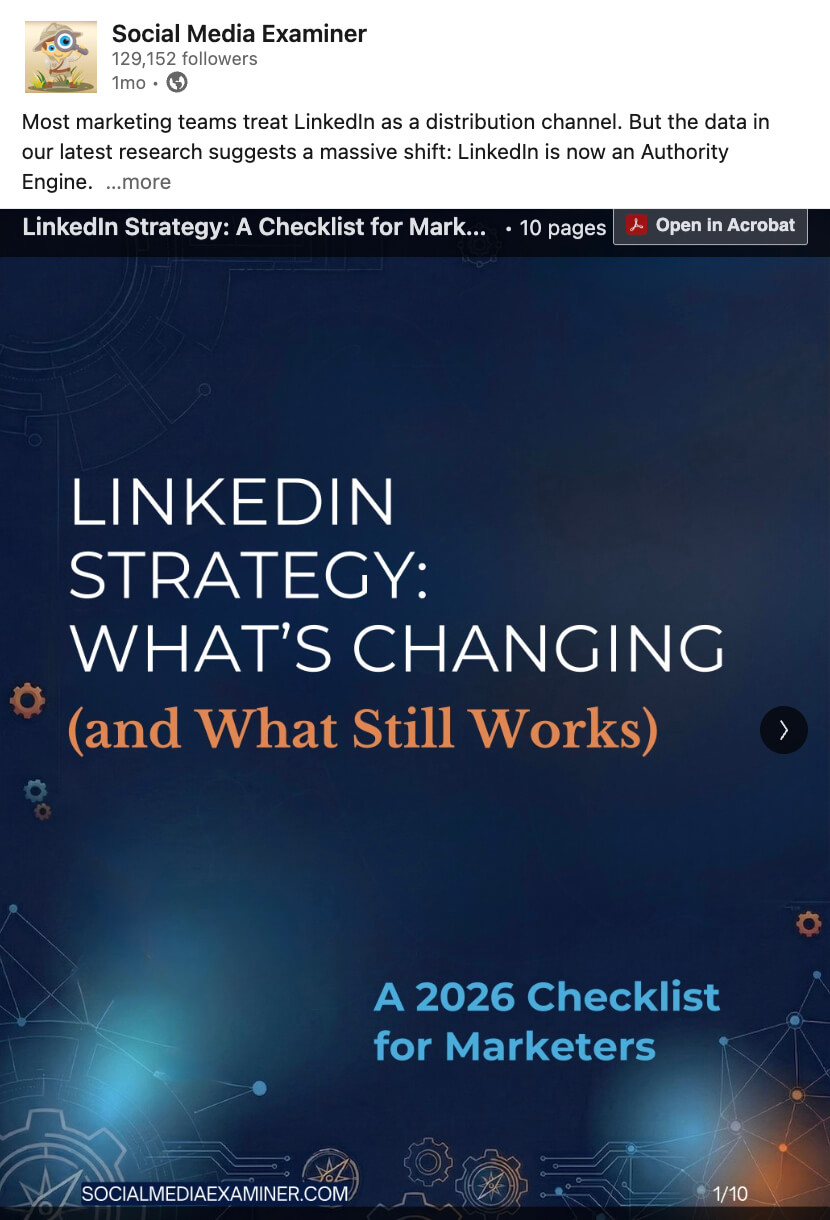
Write Openings That Earn the “…more” Click: Half of all impressions on a LinkedIn post occur within the first 48 hours, and posts with little early engagement effectively stop showing up at all. Clicking “…more” to expand a truncated post is an invisible interaction, and AJ believes it is almost certainly a signal the algorithm tracks.
A strong hook, one that creates genuine curiosity without giving everything away, can meaningfully extend how many people read your full post, which in turn signals to the algorithm that your content is worth distributing further.
Two approaches work particularly well:
- Start With Emotion: Share the feeling you had when something unexpected happened.
- Start With Action: Drop the reader directly into the middle of a situation. A useful editing technique for this opening is to write your post, then skip down to the most interesting moment and try deleting everything above it. You will often find the long setup you thought was necessary isn’t.
End of Every Post With a Question to Generate Comments: Posts that include a question or prompt generate 77% more comments. But framing matters. A generic “Drop your thoughts in the comments” performs worse than a question tied specifically to what you just wrote about.
The underlying principle is simple: if you want someone to take an action, you have to explicitly invite them to do it. Most people who might have something to say simply do not know where to start. A clear, specific question removes that friction. Something along the lines of “Have you tried this?” or “I'd love to hear what you think about [specific element of the post]” opens the door without feeling mechanical.
AJ adds that answering every meaningful comment builds an expectation over time. His audience knows he will respond, which increases a reader’s willingness to comment in the first place.
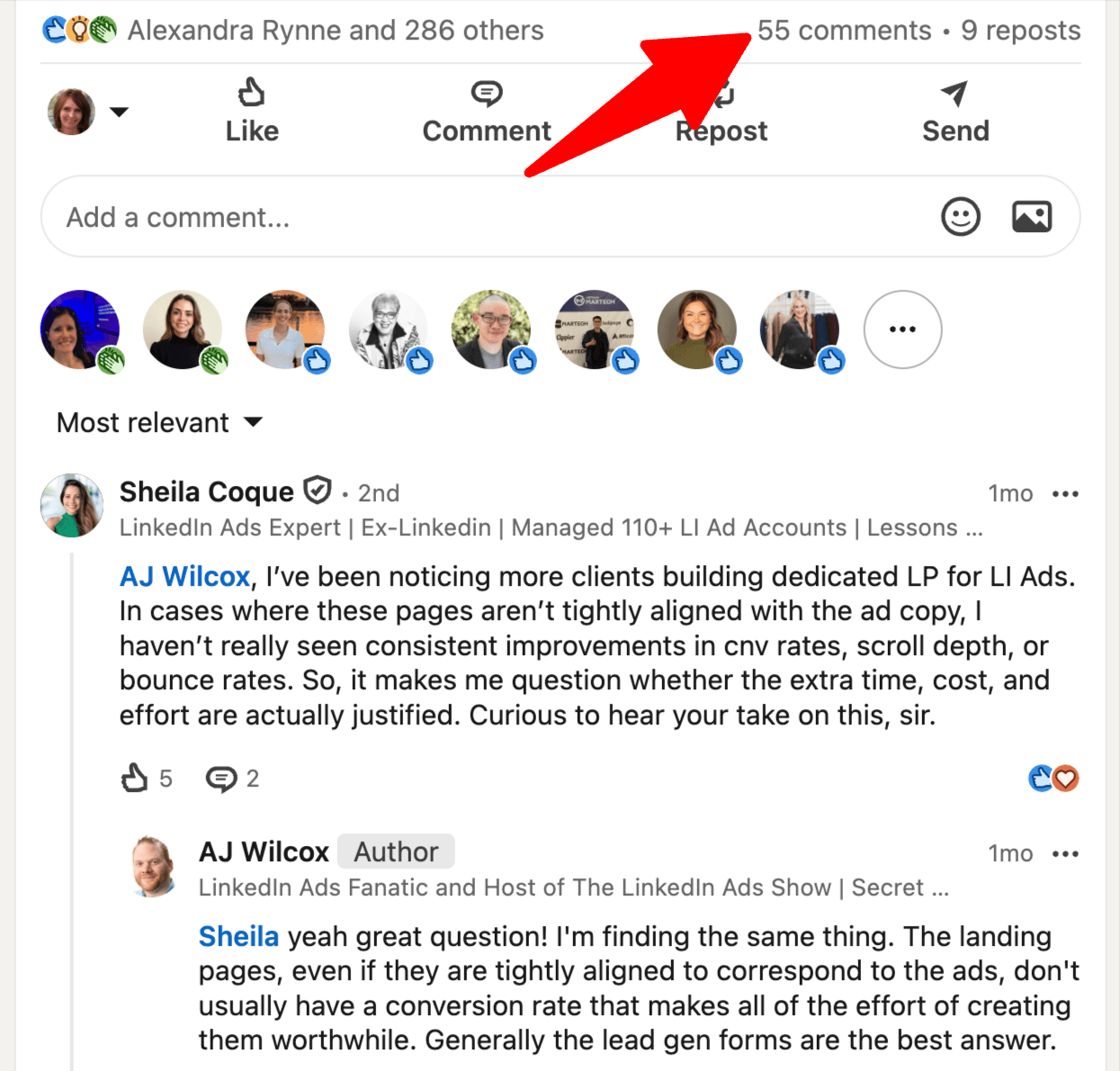
Prioritize Comment Density: LinkedIn no longer looks only at the number of comments on a post. Now, the algorithm considers the depth of the conversation within a thread, looking for real dialogue as a signal that something valuable is happening on the post.
A shallow exchange, where someone writes a one-line reaction and you reply with a brief acknowledgement, sends a far less meaningful signal than a back-and-forth conversation in which both parties engage substantively.
Early engagement signals to the platform that the post is active and worth surfacing to additional users, so AJ recommends responding to comments as quickly as possible after publishing, particularly within the first hour.
That said, not all comments deserve the same level of engagement.
Focus your replies on comments that engage with something specific in what you wrote, rather than AI-generated comment spam. The latter’s most obvious version appears within minutes of publication, with multiple comments appearing nearly simultaneously and worded almost identically.
AJ Wilcox is the world's leading LinkedIn Ads expert and teaches businesses how to drive high-quality B2B leads at scale. He is the founder and CEO of B2Linked and the host of The LinkedIn Ads Show podcast. Follow him on LinkedIn.
Other Notes From This Episode
- Connect with Michael Stelzner @Stelzner on Instagram and @Mike_Stelzner on X.
- Connect with Jerry Potter on LinkedIn and YouTube.
- Watch this interview and other exclusive content from Social Media Examiner on YouTube.
Listen to the Podcast Now
This article is sourced from the Social Media Marketing Podcast, a top marketing podcast. Listen or subscribe below.
Where to subscribe: Apple Podcasts | Spotify | YouTube Music | YouTube | Amazon Music | RSS
✋🏽 If you enjoyed this episode of the Social Media Marketing podcast, please head over to Apple Podcasts, leave a rating, write a review, and subscribe.
Stay Up-to-Date: Get New Marketing Articles Delivered to You!
Don't miss out on upcoming social media marketing insights and strategies! Sign up to receive notifications when we publish new articles on Social Media Examiner. Our expertly crafted content will help you stay ahead of the curve and drive results for your business. Click the link below to sign up now and receive our annual report!
Discover Proven Marketing Strategies and Tips
Want to go even deeper with your marketing? Check out the Social Media Marketing Podcast! Publishing weekly since 2012, the Social Media Marketing Podcast helps you navigate the constantly changing marketing jungle, with expert interviews from marketing pros.
But don’t let the name fool you. This show is about a lot more than just social media marketing. With over 650 episodes and millions of downloads each year, this show has been a trusted source for marketers for well over a decade.