by
by Wondering how other companies get customers to actively promote their business? Want to explore a proven framework that turns one-time buyers into lifelong advocates?
In this article, you'll discover how to create superfans using a proven five-step framework that transforms customer experience into customer loyalty and referrals.
Why Customer Experience Matters for Marketers
Marketing generates attention, qualifies prospects, and creates excitement. But it doesn't matter how amazing your marketing campaign is—if someone tries your product and feels disrespected, encounters rudeness, or finds it doesn't live up to expectations, they won't come back, no matter how clever your next campaign is.
Customer experience delivers on the promises marketing makes and creates continuity that lasts.
Every touchpoint from pre-purchase to post-purchase provides evidence that people use to shape how they feel about you and how likely they are to talk about you.
Experience is the number one differentiator between your brand and every other brand, and it's the hardest thing for your competitors to copy. It’s also where you have the deepest ability to create superfans.
So, the question you have to ask yourself is, “Is your brand easier to refer or to forget?”
The SUPER Framework for Creating Superfans
If people view your business as a commodity, it’s seen as a solution, but not the perfect solution. You want to be seen differently.
Customer experience is how you say to consumers, “We are not a commodity provider. We are a category of one.”
The SUPER framework provides five steps to creating customer experiences people will remember, share, and come back for. Each element builds upon the previous one, much like steps on a ladder or layers in a pyramid.
#1: Start With Your Story
One of the hardest things to measure is how many prospects you lost before you knew they existed. How many people were told about you and said “meh” and moved on?
Stories are more trusted, more remembered, and more shared than any other form of marketing.
Superfans are created at the intersection where your story and your customer's story overlap. At that intersection, your product or service becomes so relevant to their life that they can't ignore it and don't want to make a different choice.
These tips will help you create a story that is compelling enough for people not to ignore it and to share once they hear about or experience it.

Marketers Are Learning AI Alone
Sound familiar? 85% of marketers learn AI by experimenting on their own, just 7% get company training, and more than half spend their own money on tools.
Our third annual AI Marketing Industry Report surveys 681 marketers and distills everything into 32 clear charts — what's working, what platforms marketers rely on, and what to learn next.
SKIP THE GUESSWORK — READ THE REPORTGather Your Internal Stories: You first need to develop your founder origin story. Why did you choose to do this? You could be doing anything in the world, but you're doing this specific thing. Why? How you and your executive team tell that story becomes critical not just for marketing, but for raising money and aligning people with your cause.
Next, look to your team. Every person on your team has a story, too. Each person chose to join this mission. What elevates their work beyond a paycheck to the level of purpose or passion? Finally, give your team the tools to tell these stories.
Collect Your External Stories: Testimonials are a good place to start, but if you want to go deeper, ask your customers, “Hey, if you were going to tell someone about us, what would you say?” Then listen.
This question reveals what they find interesting, memorable, important, or unique about your business.
Pay attention because stories are everywhere around you, but not every story is worth telling. If you think something is boring, pedestrian, or just like everybody else's, your audience will likely think the same.
So which stories do you tell?
The best marketers and salespeople maintain a repertoire of stories and use that story set list to determine the right story to tell at each moment based on what they know about the situation.
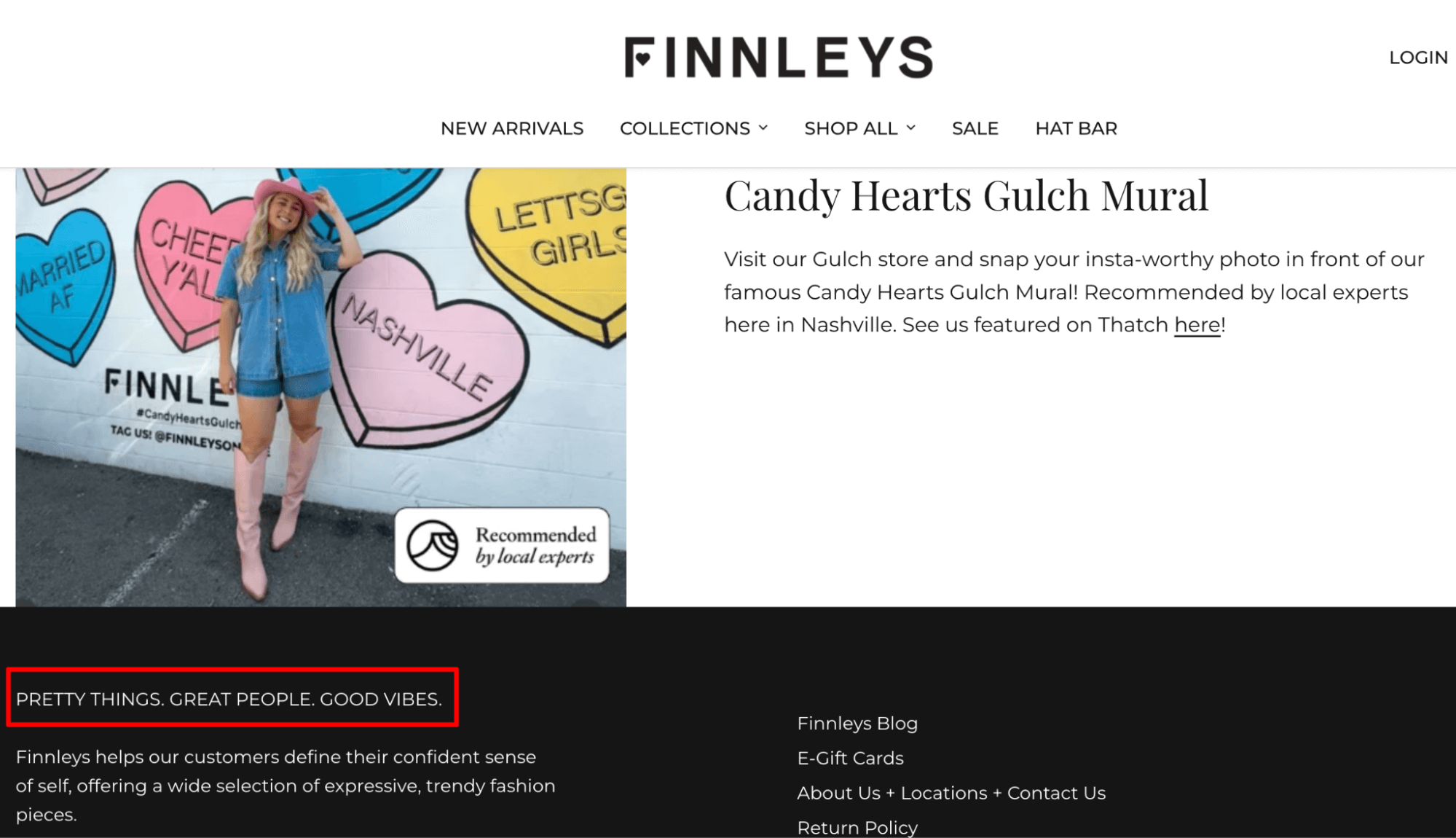
Crystallize Your Story With a Tagline: Taglines and mottos serve as concise versions of your brand's story or promise.
A clothing store in downtown Franklin, Tennessee, demonstrates this perfectly. Their tagline—”pretty things, great people, good vibes”—tells you everything they're about in six words. These six words became the operating principles that define what customers can expect and what the company promises to deliver.
#2: Understand Your Customer’s Story
Now, you need to find a genuine way to tie your story to your customer’s story. To do that you have to get crystal clear on who you want to serve and create an avatar of that person.
There are the standard questions you can ask: What's important to your customers? What are they struggling with? What transformation are they looking for? What do they need help with?
But understanding your customer's story doesn't have to require a forty-five-minute interview.
Look for a logo on their clothing that shows they're a fan of the same team you support. Notice if they have a diaper bag. Look for ways to better understand who they are, then identify overlaps in what matters to you and what matters to them, which may or may not relate to what you're selling.
The Cookie Shop
For example, a gentleman at a cookie shop in Hawaii asks everyone the same questions when he’s ringing them up: “Where are you visiting from?” He then shares something relevant about that person’s home.
Why does he ask this question? He finds it fascinating to think about the cookies he makes traveling all around the world. He goes home each day and tells people that something he made is going back to Cape Town, Sydney, or Marrakesh.
This works because he's asking one question to find out where his cookies are going and following up with something that demonstrates his interest in the customer’s answer.
While this approach works for in-person commerce, when you're selling online without direct interaction, you still need to find a way to connect with people and make them understand why they should care about you and what you offer.
Think about what you might know about someone without having met them personally. What do you know about their industry? What changes could be affecting their business? There are always details you can use as a starting point to deduce what might matter to someone.
#3: Personalize
Personalization is about making each customer feel like your most important one, even when operating at scale with hundreds of thousands of people. It’s finding ways to make them think, “Oh, wow, this was a little easier than I expected” or “This was a little more delightful.”

Which AI Moves Actually Matter?
That's what every marketer is wrestling with now. New AI strategies, new tools, new takes every week — but no clarity. Most marketers and business owners are trying to figure out AI alone.The AI Business Society is your trusted guide. Get expert-led training you can put to work immediately. Plus a community of marketers sharing what's actually working.
I'M READY FOR REAL AI RESULTSPersonalization can be categorized into two main buckets: high-tech and high-touch. Smart companies consider how these buckets overlap, because when high tech and high touch work together, they create the highest degree of impact.
Here are three examples for inspiration.
High Tech + High Touch: The Hot Chocolate Maker
A hot chocolate maker company sends emails with video content to customers at each stage of their order journey.
On package delivery day, the company sends: “Your order delivers today! We thought you might want to take a couple of minutes to watch this unboxing video so you know exactly what's in the box.”
After delivery, the next email says: “OK, we know you want to get started as soon as possible. So here are a few quick and easy recipes you can make with your cocoa maker.”
Instead of sending an inventory of what was ordered and a tracking number, the company delivers the right content at the right time based on information from different systems it has access to.
High Touch: The Car Wash
A car wash manager was looking for ways to keep subscribers longer.
Now, when someone goes through the car wash tunnel with a kid, the attendant drying the car hands the kid a Hot Wheels car and says, “Mom and dad are doing a great job keeping their car clean. I want you to keep this car clean for me.” This simple gesture has a dramatic impact on retention and repeat visits.

High Touch vs. High Tech: The Realtors
Two real estate agents Brittany spoke to execute a similar high-touch in very different ways.
One agent's favorite closing gift involves having Etsy artisans create a replica of the new home as a birdhouse for the front yard.
Another realtor buys new homeowners a Birdbuddy feeder, then swaps postcards of birds with them from her own feeder.
One execution is high-touch, while the other is high-tech. Both executions have a high impact because they feel personalized and connect each realtor’s story to their customer's story.
#4: Exceed Expectations
If you're only meeting expectations with your product or service, you might end up in the commodity zone.
The expectation is that you're amazing at what you do. That's literally your job. Where you create superfans, earn referrals, and make people want to save your contact information and come back is by going above and beyond in other areas.
Consider the problems surrounding your core service. What would allow you to add value and differentiation to the service you’re being paid for? What could make your customers' lives easier in ways they haven't even thought to ask for?
Here are two examples of businesses who get it right.
The Roofing Company
When replacing a roof, doing good work on the shingles and flashing isn't the ceiling—it’s the floor. It’s what you have to clear.
This particular roofing company differentiated itself not through better shingle work, but through a different practice. They know stray roofing nails can end up in tires, lawn mowers, or a child's foot.
At the end of each job, they send a team out to walk the property with a magnet, collecting any nails that might have fallen into the yard. Then, after the first rain, they return to do a final sweep.
This attention to detail—showing they care whether customers get a nail in their tire or foot—is what creates recommendations. When someone asks for a good roof company, this company gets the referral not because of their shingle work, but because of the level of care surrounding that work.
The Plumber
When a repair plumber noticed toddler boys in Brittany’s home, he asked if they were potty training either of the boys. When the answer was yes, he asked, “Do you know about the targets?”
He pulled out a stack of poker chip-sized little paper circles with dinosaurs on them. “You just drop one of these in the toilet. And then when he aims at it, if he has good aim, the dinosaur sinks. And so it's a game. Can you sink the dinosaur?”
This was a total differentiator. It made life easier for Brittany by helping both boys develop better aim.
His business card made its way to the refrigerator and is still there years later. Not because he fixed the toilet faster than the last guy, but because he went above and beyond.
#5: Repeat
Elizabeth Arden said, “Repetition makes reputation and reputation makes customers.”
That principle holds true today. Repetition isn't boring—repetition is branding, and your consistent execution of a predictable customer experience builds superfans.
You can't exceed expectations once and declare victory. You’ll have to put systems and processes in place to turn everyone on your team into what Hodak calls “the acting chief of experience.”
Brittany Hodak is a customer experience expert and keynote speaker. She is the author of Creating Superfans: How to Turn Your Customers into Lifelong Advocates and creator of the Six Weeks to Superfans Masterclass. Her podcast is The Creating Superfans Podcast. Follow her on Facebook, Instagram, LinkedIn, and YouTube.
Other Notes From This Episode
- Connect with Michael Stelzner @Stelzner on Instagram and @Mike_Stelzner on X.
- Watch this interview and other exclusive content from Social Media Examiner on YouTube.
Listen to the Podcast Now
This article is sourced from the Social Media Marketing Podcast, a top marketing podcast. Listen or subscribe below.
Where to subscribe: Apple Podcasts | Spotify | YouTube Music | YouTube | Amazon Music | RSS
✋🏽 If you enjoyed this episode of the Social Media Marketing podcast, please head over to Apple Podcasts, leave a rating, write a review, and subscribe.
Stay Up-to-Date: Get New Marketing Articles Delivered to You!
Don't miss out on upcoming social media marketing insights and strategies! Sign up to receive notifications when we publish new articles on Social Media Examiner. Our expertly crafted content will help you stay ahead of the curve and drive results for your business. Click the link below to sign up now and receive our annual report!
Discover Proven Marketing Strategies and Tips
Want to go even deeper with your marketing? Check out the Social Media Marketing Podcast! Publishing weekly since 2012, the Social Media Marketing Podcast helps you navigate the constantly changing marketing jungle, with expert interviews from marketing pros.
But don’t let the name fool you. This show is about a lot more than just social media marketing. With over 650 episodes and millions of downloads each year, this show has been a trusted source for marketers for well over a decade.