by
by Do you feel like your investment in AI tools isn't yielding the organizational productivity gains you expected? Are you struggling to move beyond individual experimentation to see a real transformation in how your entire team works?
In this article, you'll discover a human-first framework for AI adoption that addresses psychological biases, identifies specialized user mindsets, and provides a three-layer strategy to activate your business.
How You Roll Out AI Integration In Your Business Affects Productivity Results
AI is transforming the workplace, but deploying AI tools alone won't lead to transformation.
When ChatGPT was first released to the world at the end of 2022, Kristin Ginn, the product marketing lead for AI adoption and usage at Microsoft and founder of the consultancy TrnsfrmAItn, started playing around with it. She explored how she could use AI both at work and in her personal life, and realized just how powerful the technology would be.
Around the same time, research started showing that people using generative AI at work were being more productive, and the quality of their work was improving.
Fast forward a year to 18 months to early 2024, and a different narrative started emerging. Organizations that had invested in AI were saying they weren't really seeing impact from their AI investment and weren't sure if it was actually worth it.
Ginn had seen first-hand how powerful AI can be at the individual level, so she had a fairly difficult time understanding how those individual productivity gains didn't translate to productivity gains at the organizational level.
She started researching this disconnect, talking to leaders, colleagues, and friends. That's when she realized the issue isn’t a technology challenge; the technology itself is relatively easy to use. The issue is a human readiness challenge.
It's human nature to avoid change, so your task is to help your people overcome that avoidance and embrace a new way of working. To do this, you have to understand what might hold them back and how you guide them from avoiding AI to embracing it.
How to Implement Human-First AI Adoption in Your Business
There are three key biases that make change, like the adoption of AI, particularly challenging.
First, there's fear of the unknown. When we don't understand what AI means for our work, organization, or ourselves as human beings, we tend to become anxious or even scared.
Second, there's status quo bias. Change is uncomfortable, and we are wired to view the way we have done things in the past–the comfortable way, as better than a new alternative, because it feels uncomfortable.
Third is loss aversion. Change means something is going away to make room for something new. In the case of an AI rollout, this touches on work habits and routines. The loss of those habits and routines can often be perceived as more negative than the potential positive impact of productivity gains and a higher quality of work.
Your task is to help your people overcome that avoidance and embrace a new way of working. These tips will help you design an AI rollout that puts humans first, so they embrace AI more readily.
Ready to Supercharge Your Marketing Strategy?
Get expert training and an unbeatable conference experience when you attend Social Media Marketing World—from your friends at Social Media Examiner.
Broaden your reach, skyrocket your engagement, and grow your sales. Become the marketing hero your company or clients need!
🔥 Save $530 on an All-Access ticket. Sale Ends Wednesday! 🔥
GET THE DETAILS#1: Account for Three Types of AI Users in Your Organization’s AI Rollout
Ginn identifies three distinct AI user types when working with organizations to integrate AI. Organizations must find ways to speak to every user type to achieve a successful rollout.
Champion Users
Champion users are genuinely excited about AI. They couldn't wait to get access to the tool and use it every day, actively seeking ways to apply it. They experiment with the technology, discover new use cases, and truly reimagine how their work gets done.
When organizations roll out generative AI tools like Google Gemini or Microsoft Copilot, champion users drive the most usage right from the beginning because of their enthusiasm.
Based on Ginn's conversations with organizations, champion users typically represent about 5-7% of the workforce.
Reluctant Users
On the opposite end of the spectrum are reluctant users. They're either completely uninterested in AI or skeptical because they tried it before and it didn't work for them.
Often, their negative experience stemmed from poor prompts or using the technology in unintended ways, resulting in disappointing responses.
Reluctant users need the most handholding from organizations and leaders, requiring step-by-step guidance to give AI another chance.
The size of this group varies significantly based on industry, and organizational culture plays a crucial role. Companies that embrace experimentation and treat failure as a learning opportunity tend to have fewer reluctant users. However, if failure is something the organization absolutely wants to avoid, the reluctant bucket grows larger because people view AI as a path to mistakes.
Moving reluctant users to the next level of a curious user requires convincing them that the change is worth the effort because there's something in it for them.
Start conversations with users closer to the reluctant end of the spectrum by asking, “Hey, what are the one or two tasks that you wish you wouldn't have to do every day, every week?” When users identify such tasks, respond with, “Okay, let's work together and figure out how you can use generative AI to handle most of that work, and then all you do is finish it, and you can move on to the next.” This approach makes use cases tangible and relevant.
Curious Users
Curious users occupy the middle ground. They're open to using AI but don’t experience the champion's excitement or the reluctant user's skepticism. Most users fall into the curious category, and it typically comprises 50-70% of your organization.
When provided with a prompt, use case, and guidance, curious users will start using AI and work through the change. They just need a bit of hand-holding to get them started.
Enablement teams and leaders who provide three relevant use cases and starter prompts will find curious users willing to play around with AI and adapt their workflows.
#2: Execute a Three-Layer Implementation Strategy
Implementing organizational change requires more than treating AI as a simple technology rollout.
Change requires aspiration, inspiration, and motivation. To achieve all three, you’ll need to activate people across three layers of your organization.
Layer 1: Look to Leadership to Set Aspirational Examples
The first layer involves leaders driving change from the top down.
If your leaders aren't actively using or discussing AI, they send a clear message: “AI is not important. I don't have to go through this change because my leaders don't care whether we use it.”
Leaders need to actively use AI and make that usage visible—though not through constant announcements exhorting people to use AI.
Instead, if you have a monthly meeting for the entire team and your leader sends out an email with the agenda before that meeting, imagine there's a little note that says, “This agenda was generated with the help of AI.” Now you have a visible example that shows your leaders are using AI in their everyday work.
Leaders can also dedicate the first five minutes of weekly meetings to asking, “How did AI help you this week. What is a win that you had with AI?” This demonstrates leadership's genuine interest in AI adoption across the team.
Layer 2: Encourage Champions to Share Inspirational Examples of What’s Possible
AI Is No Longer Optional for Marketers—Ready to Master It?
Join over a thousand forward-thinking marketers at AI Business World—a conference-in-a-conference at Social Media Marketing World.
Get two days of practical AI training where you'll discover:
✅ Systems that 3x your output—leaving time for strategy and creativity
✅ Proven strategies you can deploy right away—no guesswork, no wasted budget
Become the indispensable AI expert your company needs.
GET YOUR TICKETS—SAVE $200The second layer focuses on inspiring change from within through enablement teams and champions. These active AI users, likely the most expert with generative AI, discover use cases and demonstrate possibilities.
When champions share their wins and use cases, they normalize AI use across the organization and provide concrete examples of what's possible.
For example, if Bob just used AI to reinvent how he creates his monthly expense report but doesn’t tell anyone, no one else knows that’s possible. But if he shares what he’s done and how, he motivates other people who also do monthly expense reports to do the same thing.
Layer 3: Support Individual Team Members with Motivational Resources
The third layer involves building from the bottom up as individual users start incorporating AI into their daily work and developing sustainable habits.
#3: Use the Four Mindsets Framework to Accelerate AI Adoption
Simply making tools available overwhelms people with too many options and unclear starting points.
With countless use cases for generative AI, people often struggle to identify where to start. Too many options can become paralyzing rather than empowering.
Ginn developed a framework using four mindsets or lenses that she teaches in workshops. The framework helps people pause when facing a new task and ask themselves, “Can this mindset help me with that? Can I do it with AI?”
Mindset 1: AI as the Assistant
The assistant mindset focuses on using AI to complete tasks faster. AI handles the bulk of the initial work while you complete the final portion.
Mindset 2: AI as the Explorer
The explorer mindset helps you use AI to think in different ways, gain different perspectives, and weigh pros and cons.
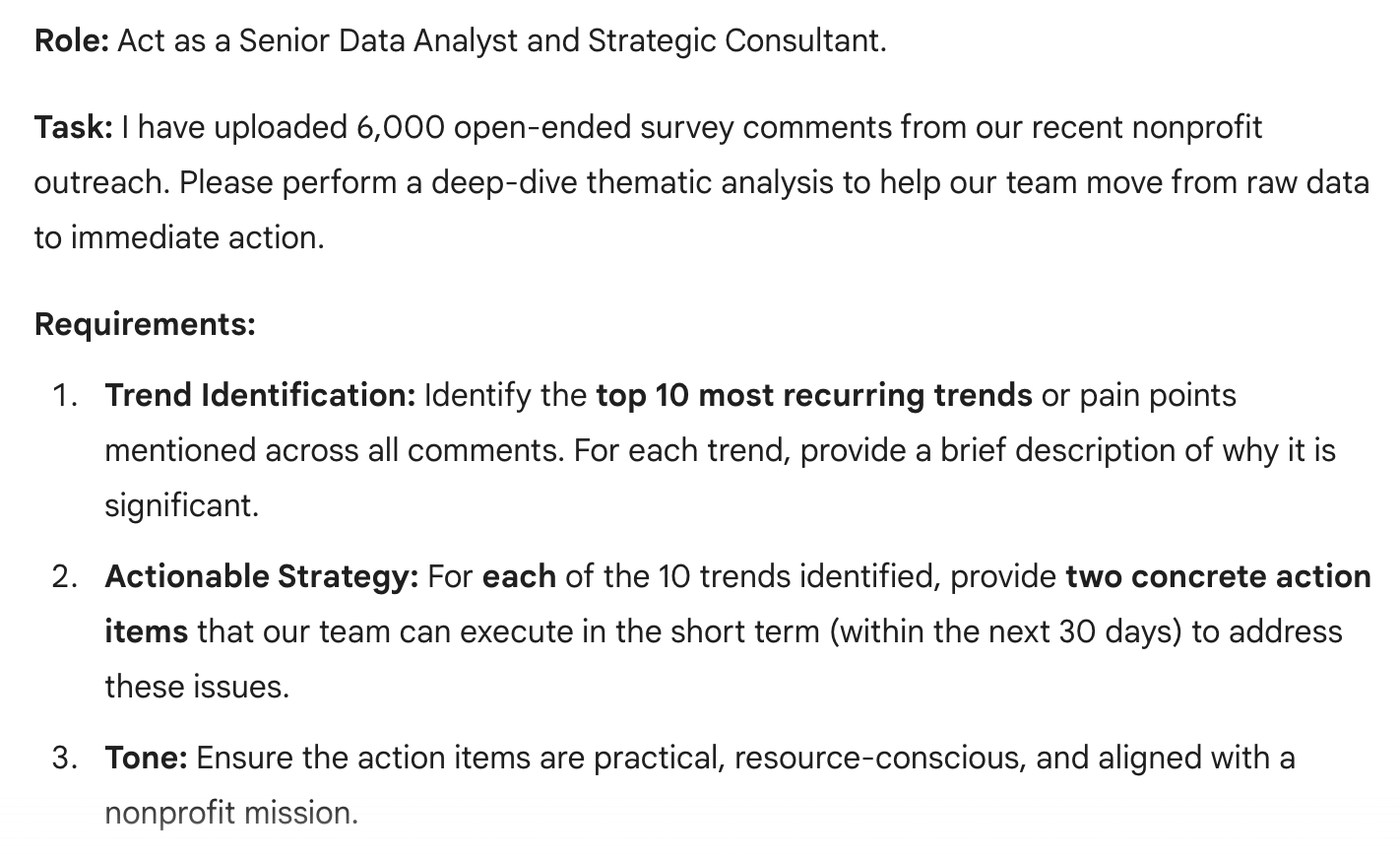
Ginn shares a concrete example from her nonprofit work. The team receives a lot of open comments as part of the surveys they send out. In the past, a team would divide 6k comments among 10 different people who would spend a month tagging and categorizing them. Then they would meet and try to identify trends based on what each person had found in their lot of comments, so they could take action.
Using the explorer mindset, Ginn uploaded all the comments to AI. She asked it to review the comments, give her the top 10 trends, and then give her two action items for each trend the team could execute on in the short term to address the issues that came up.
What used to take 10 people a month took Ginn just 15 minutes.
Mindset 3: AI as the Editor
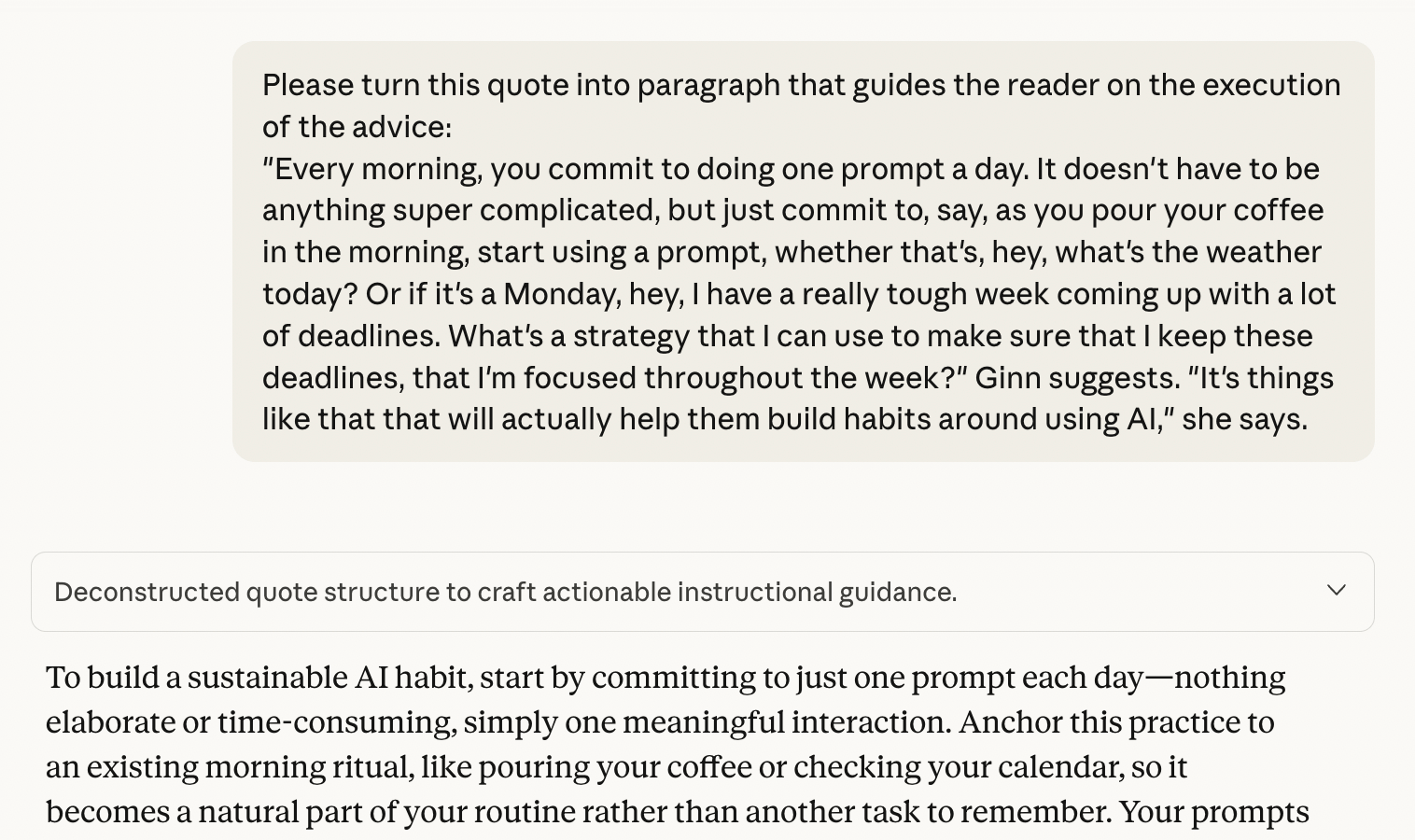
The editor mindset helps you use AI to improve existing work—whether you created it yourself or started it with AI through the assistant mindset.
You might rewrite something to make it sound more professional, more concise, or more persuasive, or you might analyze data and extract the key findings from it.
Mindset 4: AI as the Coach
The coaching mindset is what Ginn considers the most powerful yet most underutilized approach to AI.
This mindset shows you how to use AI to learn and grow in ways that resonate personally.
Imagine you want to learn about blockchain technology, but the articles are complicated and difficult to understand. Now imagine you’ve played tennis your whole life and understand it inside and out. You can ask AI to explain blockchain technology to you using tennis analogies.
#4: Help Your Team Build Sustainable AI Habits
After showing people what's possible through the four mindsets framework, provide practical guidance for establishing new work routines that include the habitual use of AI.
Ask People to Commit to One Prompt a Day
Ginn recommends starting with a simple daily commitment: one prompt each morning. The complexity doesn't matter. The key is consistency.
For example, as someone pours their coffee in the morning, they can ask AI about the weather. Or, if they’re facing a week full of multiple deadlines, they can ask AI for a strategy to stay focused and meet those deadlines throughout the week.
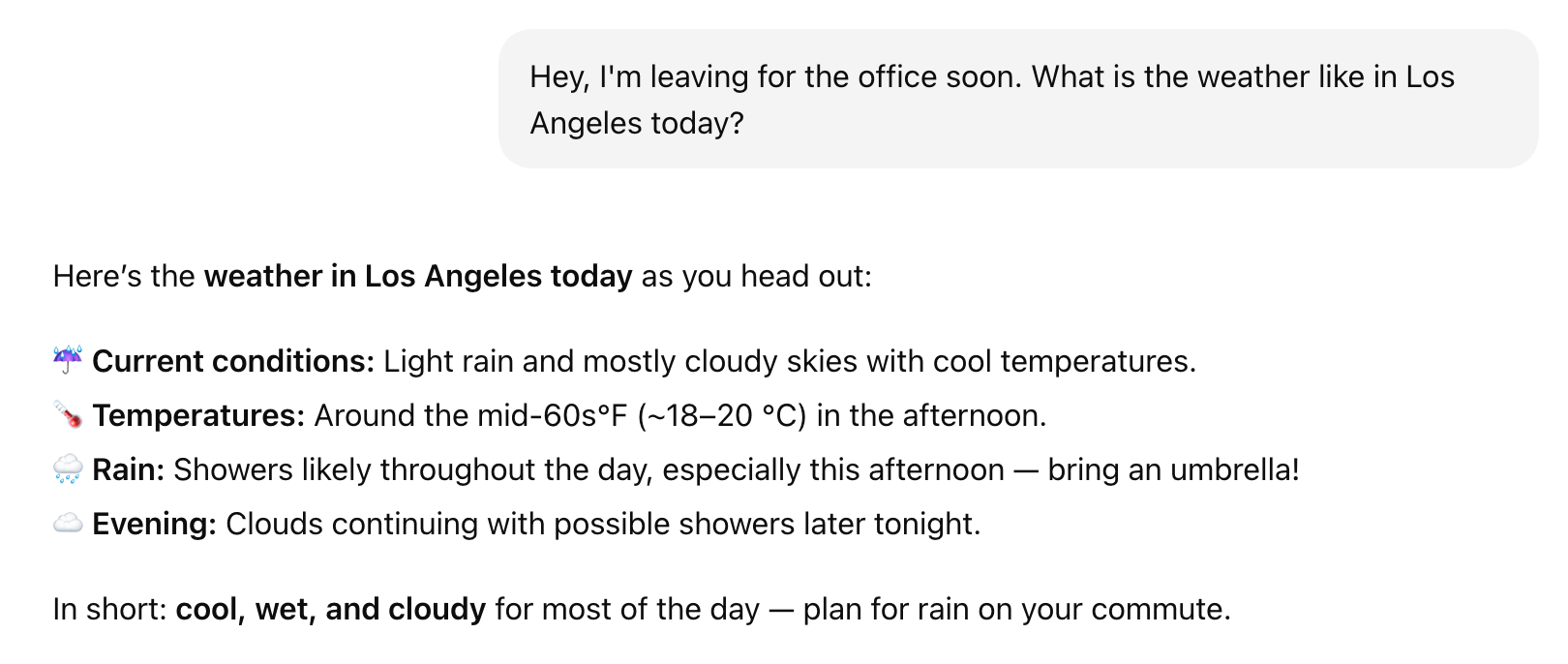
These small, consistent interactions build the habits that lead to more sophisticated AI use over time.
Tell Your Team to Expect a Learning Curve
Building new AI habits means unlearning old ways of working, which creates an initial challenge. Nobody becomes an expert immediately, Ginn explains.
Think of it in terms of star ratings. Your first attempts at using AI might produce two- or three-star results rather than the five-star outputs you're hoping for. That's completely normal and expected. The key is recognizing this learning curve as part of the process rather than a reason to give up.
Track Personal Progress With Journaling
Daily or weekly, record what you used AI for and rate the results with stars. Initially, you'll likely tackle fairly easy use cases and receive two- or three-star ratings. However, tracking will reveal a pattern: your use cases become more complex as you become more comfortable with the technology and familiar with its possibilities. Simultaneously, your star ratings climb. Four-star results become common, with five-star outputs appearing regularly.
This visible progress demonstrates concrete skill development over time.
Kristin Ginn, the founder of trnsfrmAItn, is an AI strategist who helps business owners and organizations create AI environments that place humans first. She is also the product marketing lead for AI adoption and usage at Microsoft. She hosts the AI, but Human podcast. Download her trnsfrmAItn Framework eBook, and follow her on LinkedIn.
Other Notes From This Episode
- Connect with Michael Stelzner @Stelzner on Facebook and @Mike_Stelzner on X.
- Watch this interview and other exclusive content from Social Media Examiner on YouTube.
Listen to the Podcast Now
This article is sourced from the AI Explored podcast. Listen or subscribe below.
Where to subscribe: Apple Podcasts | Spotify | YouTube Music | YouTube | Amazon Music | RSS
✋🏽 If you enjoyed this episode of the AI Explored podcast, please head over to Apple Podcasts, leave a rating, write a review, and subscribe.
Stay Up-to-Date: Get New Marketing Articles Delivered to You!
Don't miss out on upcoming social media marketing insights and strategies! Sign up to receive notifications when we publish new articles on Social Media Examiner. Our expertly crafted content will help you stay ahead of the curve and drive results for your business. Click the link below to sign up now and receive our annual report!

Want to Unlock AI Marketing Breakthroughs?
If you’re like most of us, you are trying to figure out how to use AI in your marketing. Here's the solution: The AI Business Society—from your friends at Social Media Examiner.The AI Business Society is the place to discover how to apply AI in your work. When you join, you'll boost your productivity, unlock your creativity, and make connections with other marketers on a similar journey.
I'M READY TO BECOME AN AI-POWERED MARKETER