by
by Are you sitting on genuine AI expertise but unsure how to turn it into actual revenue? Wondering whether you need to know everything about artificial intelligence before anyone will pay to learn from you?
In this article, you'll discover how to get your first clients, what to charge, and which AI services create the most natural path to paid engagements.
The Opportunity in Front of You
For professionals in their forties or fifties who built careers in a single field and feel like AI is uprooting everything they've built, the AI services market represents a legitimate second act. Generalists who understand how people learn, how organizations change, and how to communicate complex ideas have a real advantage when working with generative AI.
Anne Murphy didn't set out to become an AI strategist. After 30 years in nonprofit and higher education fundraising—specifically major gift philanthropy—she walked away to launch a company. When she stumbled into using ChatGPT for her own business, teaching others to use AI became her new mission.
By running workshops for anyone who needed help getting started with AI, Anne taught more than 4,000 people how to use it responsibly, primarily in the social impact sector. Today, she runs She Leads AI, which includes an academy, a membership, and a consultancy. She also co-hosts the AI Readiness Project podcast with fellow AI educator Kyle Shannon.
The Expert Myth
The most persistent misconception in the AI services world is that you need to know everything about AI before you can sell any services.
The reality is that in a field where no one can keep pace with every development, that standard is applicable.
The better mental model is to embrace being the fifth grader to the fourth graders. You don't need to be the leading expert in the room. You just need to be a few steps ahead of the people you're helping.
This principle has a practical consequence for how you build your AI services business. Anne encourages people to lean into their zone of genius rather than trying to cover everything. If there are areas outside your expertise, partner with someone who covers that ground.
#1: Rebrand Your Online Presence Around Providing AI Services
Before you pitch a single service, update your social profiles. If a potential client searches for you and sees only your past career, they'll conclude you're not an AI expert.
Your LinkedIn headline, your recent posts, and your about section should all signal that this is what you do now.
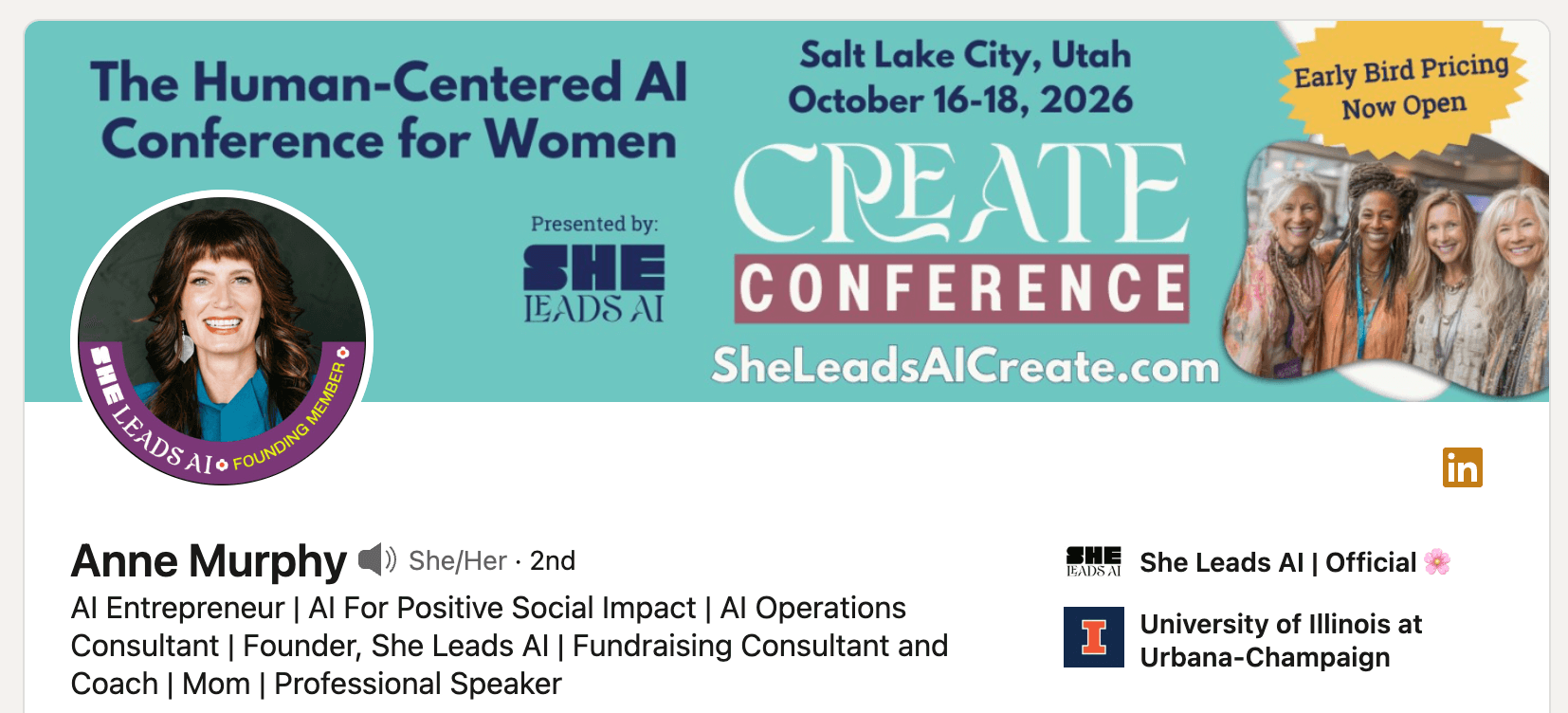
Pro Tip: Anne built a Gemini Gem tool designed to help people re-index their existing experience and see how it translates into an AI-focused identity. The rebranding itself doesn't need to be dramatic. Light updates, consistently applied over time, are enough.
#2: Two Ways to Attract AI Services Prospects
Once your profile reflects your new direction, Anne recommends one entry point above all others for landing first clients: AI education. The goal isn't perfection. It's getting in your reps.
Running workshops, even short, informal ones, is the fastest way to move someone through the know-like-trust process. It demonstrates your expertise in real time, gives people immediate value, and creates a natural opening to discuss deeper engagement.
Ready to Supercharge Your Marketing Strategy?
Get expert training and an unbeatable conference experience when you attend Social Media Marketing World this April 28-30—from your friends at Social Media Examiner.
Broaden your reach, skyrocket your engagement, and grow your sales. Become the marketing hero your company or clients need!
🔥 Save $500 on an All-Access ticket. Sale Ends Tuesday! 🔥
GET THE DETAILSAnne suggests two low-overhead approaches to get started with workshops:
- The first is to begin showing up informally via live or recorded video on LinkedIn or TikTok with other AI-curious people in your network. A 30-minute conversation with a peer where you talk through how you're using AI for real tasks is enough to start building a digital footprint around your expertise.
- The second is to list a workshop on Eventbrite. Pick a clear, audience-specific title such as AI for Small Business Owners, AI for Nonprofits, or AI Made Easy. Then, design a simple session and promote it. Eventbrite handles registrations and does its own promotion for listed events. If you price it free, there's no cost to you.
When you run your workshops, two things make the biggest difference in whether attendees want to work with you afterward. First, engineer a moment of genuine surprise—demonstrations of what AI can do that people genuinely couldn't have imagined.
4 Tips for Turning Workshop Viewers Into Clients
Don't just demonstrate on your own screen. Have everyone open their laptops and do the task alongside you. Side-by-side, hands-on execution turns a presentation into an experience.
Tailor everything to the room. At the start of every session, ask people what they do in their jobs, then build your demonstrations around those specific use cases in real time. Generic examples feel theoretical. Examples drawn from someone's actual daily work feel immediately useful—and make attendees feel seen.
After every workshop, provide a playbook. Not a recap—a step-by-step guide that captures everything covered and gives people a path forward even if they missed something in the moment.
When you close out the session, make a simple offer: If you’d like to explore working together, I have a few slots available.
#3: How to Move Prospects to Clients: Build Out Your AI Services Menu
The volume of opportunity in this space can be overwhelming, particularly for people who tend toward the visionary and the creative. Ann’s own challenge is staying focused on a small number of income streams rather than chasing every option that presents itself.
Choosing two or three services you do well—and building systems to deliver them consistently—is more sustainable than trying to do everything.
For clients who are ready to invest more significantly, an AI readiness assessment is a powerful entry point.
AI Is No Longer Optional for Marketers—Ready to Master It?
This April 29-30, join over a thousand forward-thinking marketers at AI Business World—a conference-in-a-conference at Social Media Marketing World.
Get two days of practical AI training where you'll discover:
✅ Systems that 3x your output—leaving time for strategy and creativity
✅ Proven strategies you can deploy right away—no guesswork, no wasted budget
Become the indispensable AI expert your company needs.
GET YOUR TICKETS—SAVE $150By interviewing people across the client’s organization and delivering a structured readout, you go from being someone who teaches AI to a trusted advisor who understands the client's specific challenges and opportunities.
From the assessment, several service paths branch naturally.
- You might train a specific team—marketing, operations, fundraising, or customer service—with content tailored to their actual workflows.
- You might run an all-hands session designed to bring the whole organization to a common baseline.
- You might identify a specific broken workflow and design an AI-powered solution for it.
- You might help teams evaluate which AI platforms are genuinely appropriate for their needs, potentially partnering with platform vendors whose tools fit what you're seeing.
#4: How to Charge for AI Services
Before getting into specific numbers, Anne offers an important framing: AI services pricing is the Wild West. There are no industry benchmarks. No one is the authority on what anything costs, including Anne. Her pricing is based on her own experience, and results will vary.
That said, the single most important pricing principle she's landed on is this: never charge by the hour.
Hourly billing locks you into selling your time, and there isn't enough time to make that model work at any meaningful scale. More importantly, it frames the engagement as a time transaction rather than a value exchange. Anne describes what she's actually selling as a transformation. What friction disappears? What new capability exists? The answer to those questions, not the number of hours logged in achieving the transformation, is what the price should reflect.
Before you quote anything, get on a discovery call. Anne often sends a brief questionnaire first to filter leads and gather baseline information, then uses the call itself to go deeper. On that call, she's working to answer three specific questions:
- Do they have capacity? Specifically: do they have a budget, and who makes the decision? If the person you're talking to can't approve a spend, you need to either reach the person who can or arm your contact with clear enough information that they can make the case upward on your behalf.
- What have they tried so far? By the time most clients contact Anne, they've already attempted something that didn't work. Understanding that history tells her what the real problem actually is.
- Where is the pressure coming from? Is it the boss, the board, or the team? Knowing the source of urgency shapes how she positions the work and who needs to be in the room to move things forward.
Anne identifies three ways to help clients understand and accept the value of your services.
The most straightforward is to calculate the dollars-and-cents value of what AI could change for them and anchor your fee to a share of that return. This could align with cost savings from streamlined workflows or potential revenue from new capabilities.
The second is to ask what they've paid for similar services in the past.
The third, and the one Anne finds most effective, is to focus on friction.
Friction isn't about technology. It's about the places where people are getting on each other's nerves—the broken workflows that no tool, no job description change, and no restructuring has been able to fix.
For example, a team member complains that the consultants keep submitting their proposals at the last possible second, and they're expected to design all of them within 24 hours. That's not a technology problem. It's a collaboration breakdown that AI can actually solve. When Anne surfaces that kind of pain point in a conversation, it moves faster than any financial justification she could construct. The client already feels it. She's just giving it a name and a solution.
Leveraging Pro Bono vs Paid Work
Regarding free versus paid work, Anne recommends being strategic. Some pro bono gigs are worth doing because they open doors; others are worth doing because they serve a mission you care about.
Either way, she views non-cash compensation as real compensation.
After every free engagement, Anne asks for a testimonial immediately, a social media mention, and photos or video, if available. She uses those testimonials in her proposals, on her website, and in her marketing.
She limits herself to roughly one pro bono engagement per quarter, and when she does, she clearly communicates that the training is valued at $2,500 and expects the client to engage with that level of seriousness in return.
Anne Murphy is the founder of She Leads AI and co-host of the AI Readiness Project podcast. She Leads AI includes an academy, membership, and consulting practice focused on helping mission-driven leaders implement responsible AI. Check out her free Social Saturday gathering for women in AI every week. Follow her on LinkedIn.
Other Notes From This Episode
- Connect with Michael Stelzner @Stelzner on Facebook and @Mike_Stelzner on X.
- Watch this interview and other exclusive content from Social Media Examiner on YouTube.
Listen to the Podcast Now
This article is sourced from the AI Explored podcast. Listen or subscribe below.
Where to subscribe: Apple Podcasts | Spotify | YouTube Music | YouTube | Amazon Music | RSS
✋🏽 If you enjoyed this episode of the AI Explored podcast, please head over to Apple Podcasts, leave a rating, write a review, and subscribe.
Stay Up-to-Date: Get New Marketing Articles Delivered to You!
Don't miss out on upcoming social media marketing insights and strategies! Sign up to receive notifications when we publish new articles on Social Media Examiner. Our expertly crafted content will help you stay ahead of the curve and drive results for your business. Click the link below to sign up now and receive our annual report!

Want to Unlock AI Marketing Breakthroughs?
If you’re like most of us, you are trying to figure out how to use AI in your marketing. Here's the solution: The AI Business Society—from your friends at Social Media Examiner.The AI Business Society is the place to discover how to apply AI in your work. When you join, you'll boost your productivity, unlock your creativity, and make connections with other marketers on a similar journey.
I'M READY TO BECOME AN AI-POWERED MARKETER