by
by Tired of not seeing real results from AI experiments in your day-to-day work? Wondering how to use AI to fundamentally change the way you work?
In this article, you'll discover the five-step ADOPT framework that turns scattered AI experimentation into a structured, sustainable approach to using AI to change how you work.
The Biggest Misconceptions About AI Adoption
The number one mistake Tim sees businesses make is treating an AI subscription as an AI strategy. Companies purchase ChatGPT Teams for teams of 150 people or fewer, or ChatGPT Enterprise for larger organizations, hand out logins, and declare themselves AI-ready.
Tim describes this as the equivalent of buying the best boxing gloves and expecting to fight like a champion without ever stepping in the ring.
The second mistake is operating from a position of fear. Many people worry AI will eliminate their jobs, and that fear creates a psychological barrier that slows adoption before it even begins.
Tim takes a different view: if a job consists primarily of low-cognitive, repetitive tasks, it may not have been the right use of a human brain in the first place. What AI does is create the opportunity to spend more time on problem-solving, strategic thinking, and the creative work that machines cannot replicate.
The ADOPT Framework for Integrating AI to Change How You Work
#1: Align: Establish Your Why and Your Vision
The framework begins with alignment, which Tim defines as getting both your objective (your Why) and your toolkit pointing in the same direction before you touch a single AI tool.
Different people on the same team may prefer different LLMs based on their workflow and working style, and that's fine. What matters is that those choices are intentionally rooted in why each person uses AI tools and how they connect to the team's broader objectives.
One person may use AI to become a better writer, another to write better social media posts, and another to develop code.
If someone doesn’t know their Why, Tim recommends having them write down everything they do each week and color-code it. The tasks they genuinely enjoy are marked in green, and the ones they dread are marked in red. Even people in highly administrative roles usually find at least a few green tasks buried in the red.
AI's job is to absorb the red tasks or at least complete them dramatically faster so that you can do more of the green tasks yourself. The goal isn't to eliminate your job, it's to redesign how you show up to it.
Pro Tip: Tim recommends doing this exercise with pen and paper rather than in a digital tool, because the physical act of writing it down forces clarity.
#2: Develop: Learn to Use AI Capably
Once alignment is in place, the next step is capability development. Tim describes this as upskilling. This involves working with the AI tools you have or experimenting with new tools to create custom GPTs, agents, and workflows for specific use cases.
The people who get the most out of this stage are the ones willing to experiment with AI without knowing where it will lead. Capability development in AI doesn't follow a traditional training curriculum. You discover use cases by doing, by asking the AI things you'd never think to ask a human colleague, and by following your curiosity into corners of your workflow that you previously thought were fixed in concrete.
Ready to Supercharge Your Marketing Strategy?
Get expert training and an unbeatable conference experience when you attend Social Media Marketing World this April 28-30—from your friends at Social Media Examiner.
Broaden your reach, skyrocket your engagement, and grow your sales. Become the marketing hero your company or clients need!
🔥 Save $450 on an All-Access ticket. Sale Ends Tuesday! 🔥
GET THE DETAILSAs you review the red friction points in your list, you'll often realize that some of those painful tasks are solvable with tools you already have access to; you just hadn't connected the dots.
- A task that requires you to log into a platform, run a query, export data, and paste it somewhere else might be automatable through an integration you haven't explored.
- A five-hour monthly reporting process becomes a candidate for automation.
- A LinkedIn post that takes two hours because the hook never lands becomes a task you can hand off to a trained AI assistant.
#3: Operationalize: Turn AI Skills Into Systems That Are Used Daily
Development builds individual capability. Operationalization is what turns that capability into something the organization actually uses every day.
Tim cites a McKinsey report that said roughly 95% of AI pilots fail in what he calls “pilot purgatory.” Companies develop a proof of concept, see that it works, and then never actually deploy and integrate it into how people do their jobs every day.
You not only have to embed AI workflows into the tools and rhythms your team uses, but you must also provide proper training on how those workflows change the way work was done previously, how they function, and what to do when they don't behave as expected.
Tim recommends running internal innovation competitions to find operationalization wins. The format is simple: challenge team members to find a way to reduce a time-consuming task using the tools they now have access to. These competitions create peer-to-peer learning, surface unexpected use cases, and generate buy-in from people who discover the value themselves rather than being told about it.
Pro Tip: Large language models are non-deterministic, meaning they can produce different outputs and occasionally hallucinate. But when an LLM writes Python code to pull data from Salesforce and generate a report, that code is deterministic—it runs the same way every time. Building workflows that use AI to generate reliable code, rather than relying on AI to directly produce every output, is a key strategy for increasing trust in automated systems.
Use Case: Operationalized Client Reporting
A 70-person agency had a 35-person sales team spending 15 hours per month each on client reporting. They were creating slide decks and spreadsheets by manually querying Salesforce, exporting data, and assembling it by hand.
Using a custom ChatGPT integration with Salesforce and custom actions that generated SQL queries and returned CSV exports, Tim's team reduced that 15-hour burden to 1 hour per person per month. Across 35 salespeople, that freed up 490 hours monthly—hours that salespeople who love selling immediately reinvested in client calls and outreach.
Use Case: Operationalized Newsletter Production
Tim is particularly enthusiastic about Anthropic's Claude Cowork‘s ability to help teams operationalize. Claude Cowork is a user-friendly, non-developer-focused version of Claude Code that you download to your computer. It runs from a terminal but operates in a sandboxed environment, where you choose the folder you want it to work in.
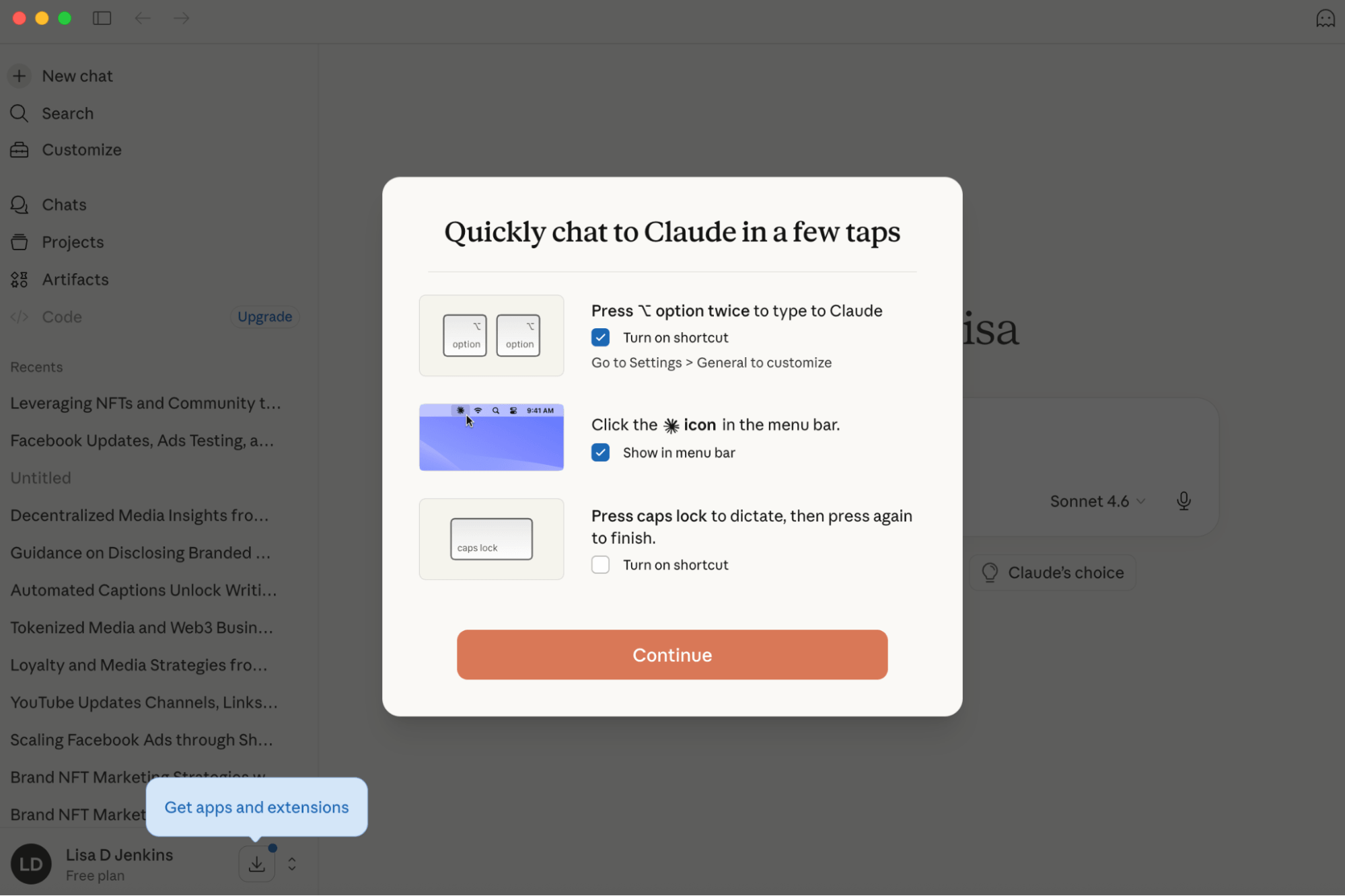
You designate a specific folder on your computer—a marketing folder, a client folder, a content folder—and Claude Cowork works only within that boundary. For users worried about AI running amok on their system, this constraint makes the tool far less intimidating.
What Tim finds most striking about working with advanced tools like Claude Code is their proactivity. Unlike early AI tools that simply waited for a command and responded, these tools ask questions, surface considerations the user hadn't thought to raise, and push back in ways that feel genuinely collaborative.
Tim breaks down the tool into three components:
AI Is No Longer Optional for Marketers—Ready to Master It?
This April 29-30, join over a thousand forward-thinking marketers at AI Business World—a conference-in-a-conference at Social Media Marketing World.
Get two days of practical AI training where you'll discover:
✅ Systems that 3x your output—leaving time for strategy and creativity
✅ Proven strategies you can deploy right away—no guesswork, no wasted budget
Become the indispensable AI expert your company needs.
GET YOUR TICKETS—SAVE $150- Commands (triggered with a forward slash) launch specific workflows.
- Skills are the underlying SOPs—markdown documents that define multi-step processes, such as how to write a newsletter, create a client report, or draft a social post.
- Connectors are integrations to external platforms like Slack, email, or calendar tools. For tasks that don't have a native Claude Cowork connector, Tim notes that Claude in Chrome can do roughly 90% of what a human can do inside a Chrome browser. It can open tabs, read pages, scrape information, and bring those details back into the conversation, working asynchronously while you focus on something else.
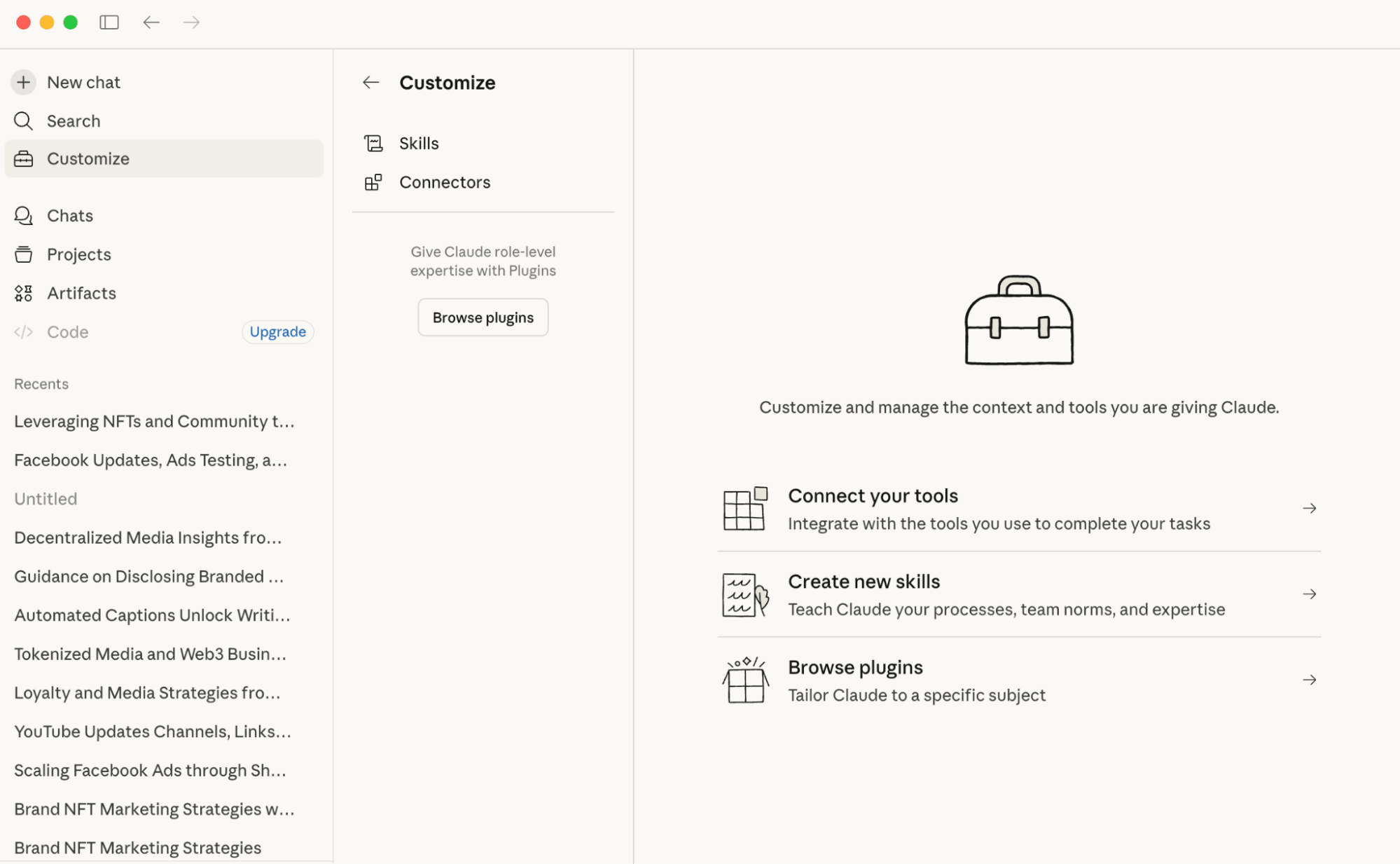
Used together, these three layers allow a single person to orchestrate a workflow that previously required a team.
To produce his newsletter, Tim points Claude Cowork to a marketing folder that contains recent articles and a writing guideline. He types the command /newsletter, which triggers a pre-built skill—a step-by-step standard operating procedure written in Markdown. The skill asks him a series of questions, such as what articles from the past week he wants to promote, what tone he wants for this issue, and what he wants to highlight.
Meanwhile, Claude Cowork uses a Connector to Claude in Chrome to pull relevant industry news for the week.
The result: a newsletter that used to take five hours to produce now takes fifteen to twenty minutes.
#4: Practice: Habitualize AI Use
Operationalization installs a system. Practice is what makes it stick. Tim describes this stage as habit formation combined with validation; continuing to use the workflows you've built until they become second nature, while simultaneously tracking where the value is actually landing.
These three tips will help your team form habits that rely on AI.
Validate
The first few weeks of using a new AI workflow are a learning phase. Catching issues early allows you to refine the underlying skill or prompt rather than letting a flawed process run unchecked.
Tim recommends paying close attention to output quality during this period to ensure not just whether the system runs, but whether it's producing work that meets your standards. Run the system several times while actively checking the output.
When you've confirmed it consistently produces reliable results, you can step back from verification.
Cross-Pollinate
One of the most powerful dynamics in the practice phase is team-level sharing.
When one person figures out a faster way to produce a deliverable, Tim encourages making that discovery visible to colleagues. Seeing a teammate turn a two-hour task into fifteen minutes is far more motivating than any top-down training session.
The organic spread of effective workflows through a team is where the real transformation begins to take root.
Build Personal AI Shortcuts Into Your Physical Workflow
Tim has developed a voice-first approach to his practice that dramatically accelerates the time it takes for his thoughts to become usable output. He uses AquaVoice as his primary dictation tool—though he notes that Flow (formerly Wispr Flow) and Superwhisper are equally viable alternatives, and several other options exist in this category.
A single tap and hold on the function key activates dictation without showing a transcript, which is useful for quick AI queries.
A double-tap locks the recording mode with a visible transcript, which he uses for longer-form thinking. He'll dictate a ten-minute stream-of-consciousness about a quarterly strategy, and the AI structures it into a clear, organized plan. What would have taken thirty minutes to type takes eight to ten minutes to speak.
He also uses Raycast, a Mac tool that replaces Apple's Spotlight search, as a command center for AI access. From the same keyboard shortcut (Command + Space), he can call any large language model, send WhatsApp or Telegram messages, search the web across ten sources simultaneously, and even control Spotify—all without switching apps.
He can also type instructions such as “Find time with Mike tomorrow,” and Raycast opens his Google Calendar, checks availability, and initiates a scheduling email, even when the other person is in a different Google Workspace. The time saved on any individual task is small, but the reduction in context-switching and cognitive load across a full workday is substantial.
#5: Transform: Build Governance and Scale What Works
The final step is where individual and team-level improvements become an organizational capability. Tim describes transformation as answering one key question: How do we sustain this?
Governance
Governance starts with something as simple as establishing a clear rule: company data stays in the company workspace.
One of the most common and damaging mistakes Tim encounters is people using personal AI accounts to process client data. A company's enterprise ChatGPT or Claude workspace has strict privacy and security settings; a personal account does not.
Beyond data security, governance means defining how AI tools will be used across teams, what information can and cannot be entered into various systems, and who is responsible for maintaining and updating the workflows built during operationalization.
Scaling
AI technology changes rapidly, and the workflows you build today will need to evolve. The transform phase is about building the infrastructure, culture, and governance to keep iterating rather than treating adoption as a project with an end date.
The goal at the end of this process is a version of your work that would have been impossible without AI: more of the tasks you love, less of the ones you don't, and the ability to co-create outputs that exceed what you could produce alone.
Tim Cakir is an AI strategist and founder of AI Operator, a behavior change and transformation company that helps businesses, teams, and agencies operationalize AI. He also publishes The AI Operator Weekly newsletter on LinkedIn. Follow him on LinkedIn.
Other Notes From This Episode
- Connect with Michael Stelzner @Stelzner on Facebook and @Mike_Stelzner on X.
- Watch this interview and other exclusive content from Social Media Examiner on YouTube.
Listen to the Podcast Now
This article is sourced from the AI Explored podcast. Listen or subscribe below.
Where to subscribe: Apple Podcasts | Spotify | YouTube Music | YouTube | Amazon Music | RSS
✋🏽 If you enjoyed this episode of the AI Explored podcast, please head over to Apple Podcasts, leave a rating, write a review, and subscribe.
Stay Up-to-Date: Get New Marketing Articles Delivered to You!
Don't miss out on upcoming social media marketing insights and strategies! Sign up to receive notifications when we publish new articles on Social Media Examiner. Our expertly crafted content will help you stay ahead of the curve and drive results for your business. Click the link below to sign up now and receive our annual report!
Want to Unlock AI Marketing Breakthroughs?
If you’re like most of us, you are trying to figure out how to use AI in your marketing. Here's the solution: The AI Business Society—from your friends at Social Media Examiner.The AI Business Society is the place to discover how to apply AI in your work. When you join, you'll boost your productivity, unlock your creativity, and make connections with other marketers on a similar journey.
I'M READY TO BECOME AN AI-POWERED MARKETER