by
by Have you ever wished you could clone yourself to handle more clients or create more content? What if AI could actually capture your unique expertise and communication style?
In this article, you'll discover how to train AI tools on your specific knowledge and personality using the Leadership Lexicon. Learn what information to collect and organize before training begins, and how to build, test, and refine custom AI assistants that truly sound like you.
How to Develop Your Leadership Lexicon to Train AI
Most marketers use AI tools like ChatGPT the same way everyone else does—with generic prompts that produce generic results.
Loren Bartley realized there was a better approach.
She developed what she calls a Leadership Lexicon—a digital clone of her knowledge that serves as her digital sounding board for strategic planning, prioritization, decision-making, and accountability. This approach transforms AI from a generic assistant into something that genuinely scales her methodology, voice, and expertise, without requiring a large team.
#1: Collect Your Raw Knowledge
Before collecting information to train AI, you need to understand what distinguishes expert knowledge from generic information. The key consideration is that you're strategically documenting knowledge that lets AI replicate your expert thinking and communication patterns, not feeding AI random information about yourself.
The collection phase involves systematically gathering the raw materials without worrying about perfection. Look for content that demonstrates how you think, not just what you know. The goal is to capture your problem-solving approach, your decision-making criteria, and your strategic perspective.
Don't overthink structure at this stage—just find a single place and dump everything there. Loren keeps an AI brain dump folder on her computer. Whenever she's doing something and thinks it's important to share with her AI tools, she dumps it into this folder.
The raw knowledge you collect will likely come from three sources:
- Core Beliefs About Your Industry and Methodology: Loren recommends using AI itself to help with this process. She created a prompt that asks her about various aspects of her business, pulling out insights you might not think to document. The conversation helps surface unconscious expertise—the things you do automatically but haven't formalized into documented knowledge.
- Content You've Already Created: This includes blog posts, emails, transcripts from training that contain your key frameworks, and training materials. For blog posts, Loren uses a tool called Manus that scrapes all her blog posts from her website and delivers them as formatted documents, without sidebar clutter or links.
- Hand-Written Notes: To turn analog knowledge from handwritten notes into digital form without hours of manual typing, Loren uses a custom GPT called Sammy Snapscribe. She opens Sammy, opens her notebook, and takes photos of the notebook pages she wants to capture. Whenever she upload a photo, Sammy creates a new canvas, transcribes whatever is in the photo, and organizes everything by the date stamps in the notes. Then she can put that canvas aside, knowing she's got it documented.
#2: Process Your Raw Knowledge: Personal DNA and Business DNA Documents
Raw information needs to be processed before AI can effectively learn from it. This phase involves curating, cleaning, and aligning your knowledge. You're not just tidying up documents—you're deciding how your knowledge should be grouped, interpreted, and used.
Loren warns against creating one massive knowledge file that tries to contain everything. Instead, one knowledge file should be about one thing. This granular approach prevents your AI from getting confused or drowning out core information in noise. It also makes ongoing updates much easier as your business evolves.
For example, your pricing document should be separate from your product descriptions document. When you split them out, you can update the price list without having to go through every product detail in a huge document.
Each document you create will fall into one of two categories: Personal DNA and Business DNA.
Personal DNA Documents
Ready to Supercharge Your Marketing Strategy?
Get expert training and an unbeatable conference experience when you attend Social Media Marketing World—from your friends at Social Media Examiner.
Broaden your reach, skyrocket your engagement, and grow your sales. Become the marketing hero your company or clients need!
🔥 Save $500 on an All-Access ticket. Sale Ends Tuesday! 🔥
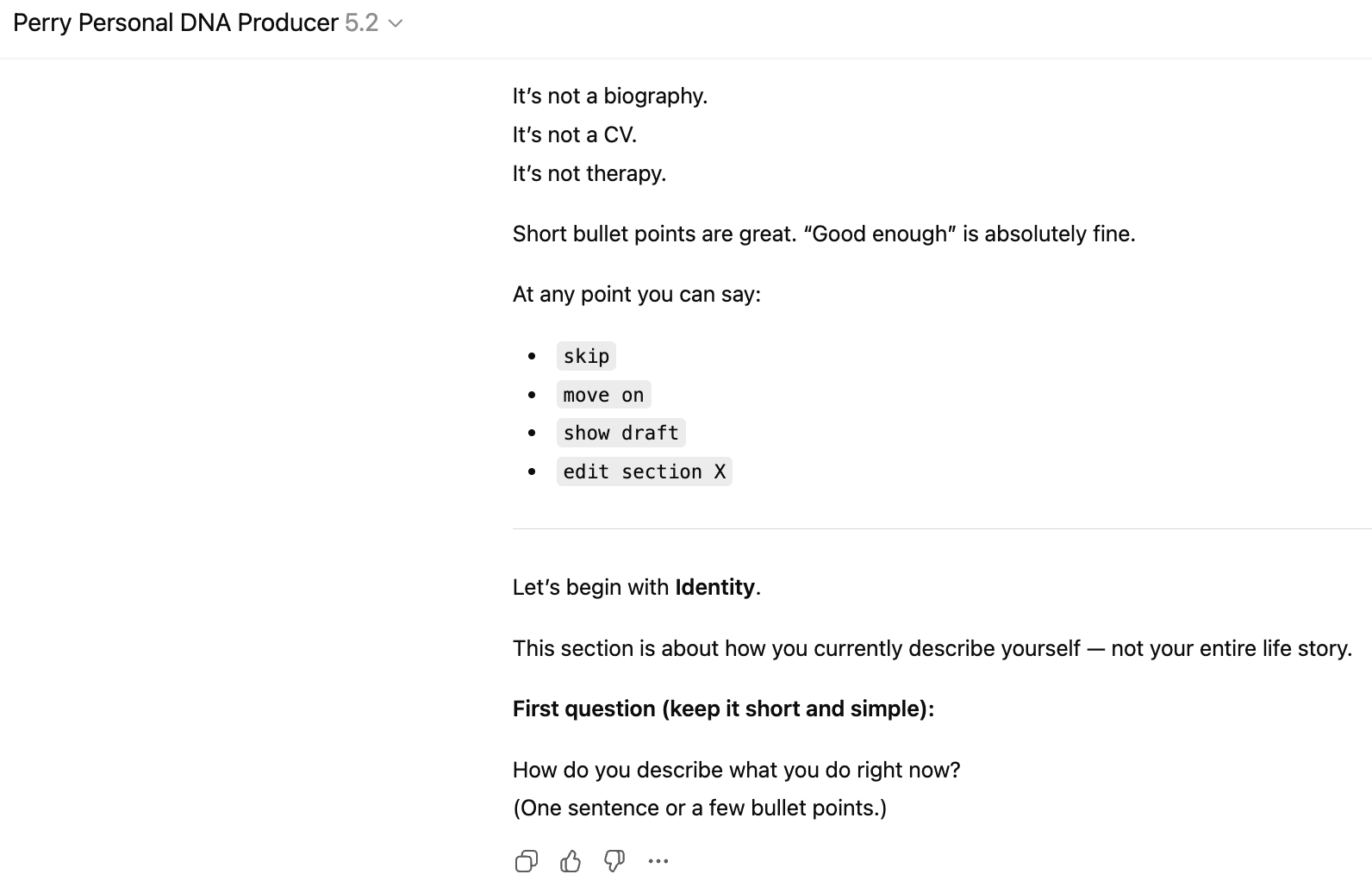
GET THE DETAILSPersonal DNA captures how you think, your stories, your values, and your vision. Logging personal details in a story bank is important in this setup. These tell AI about the stories that matter to you—the personal details that make your voice distinctive. For example, Loren's knows she runs in the park every Saturday without fail. It knows she loves swimming and stand-up paddleboarding. It knows she wants to buy an RV and travel around Australia. It even knows she met the Queen and offended her.
These details might seem trivial, but they're important to your voice. When Loren asks for an analogy, her AI might use a stand-up paddleboarding metaphor because it's part of who she is and how she would naturally talk. If she doesn't tell AI these things, it might give her an analogy about coffee—and she doesn't even drink coffee.
Loren created a custom GPT called Perry Personal DNA Producer that interviews her to extract this information.
Business DNA Documents
Business DNA includes your business goals, SWOT analysis, who you're serving, and how you're doing it. Other important knowledge files include brand voice, ideal customer avatars, products and service lists, and pricing lists.
You should also include limiting buying beliefs and positioning statements so the AI knows how you overcome customer objections in the content it creates. This ensures any content your AI creates is strategically sales-aligned, not just on-brand. You can also include frequently asked questions, testimonial reviews, and SOPs.
Finally, add your content assets from podcasts, courses, and blog posts. The problem with training transcripts is that they have lots of ums and ahs, a preamble at the beginning, and maybe a bit of Q&A at the end that goes a bit rogue. You don't want massive knowledge files full of this irrelevant content.
Loren uses a custom GPT called Trinny Transcript Transcriber to overcome this. After delivering training within her academy or any other training, Loren gives Trinny the presentation slides so GPT knows the structure. Then she gives Trinny the transcript. Trinny goes through, removes all the filler, and condenses it down to just the core knowledge.
AI Is No Longer Optional for Marketers—Ready to Master It?
Join over a thousand forward-thinking marketers at AI Business World—a conference-in-a-conference at Social Media Marketing World.
Get two days of practical AI training where you'll discover:
✅ Systems that 3x your output—leaving time for strategy and creativity
✅ Proven strategies you can deploy right away—no guesswork, no wasted budget
Become the indispensable AI expert your company needs.
GET YOUR TICKETS—SAVE $150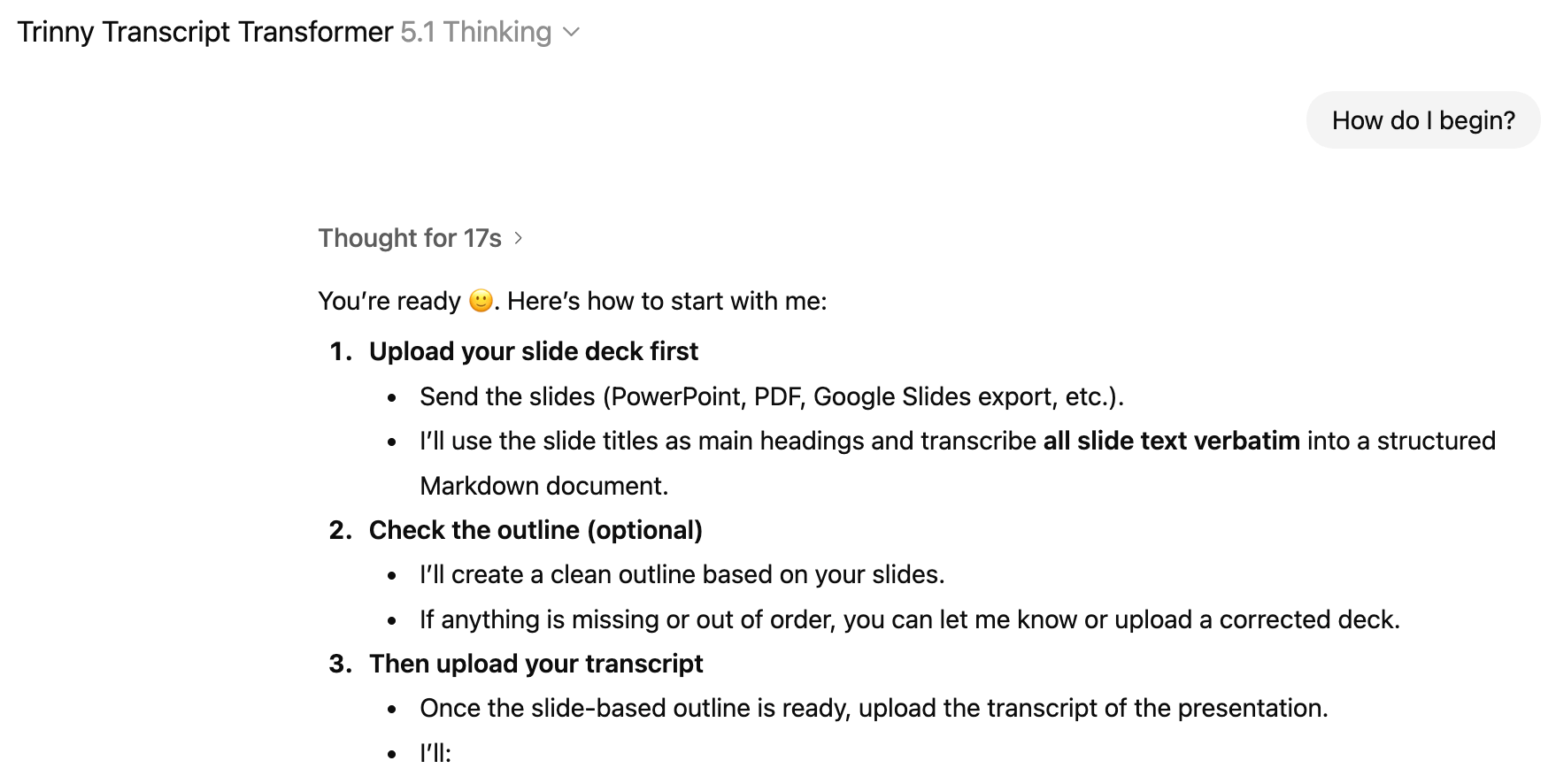
Pro Tip: Human judgment is super important in the step. Multiple documents might contradict each other, so you'll need to remove an contradictory details. You should also remove any duplication and outdated information.
#3: Build Your AI Assistants
With processed knowledge ready, you can build custom AI assistants that embody your expertise. The key is creating specialized assistants to handle specific functions rather than one general-purpose assistant. Loren has built about fifty custom GPTs and projects that she uses each week. Each one is trained on the relevant portions of the knowledge files and on specific instructions for its role.
To build a custom GPT, you start by uploading your knowledge files, then add instructions for what that particular assistant should do. The instructions define the assistant's personality and approach. For example, Loren tells her GPTs to be conversational, ask clarifying questions rather than make assumptions, and embody her teaching philosophy.
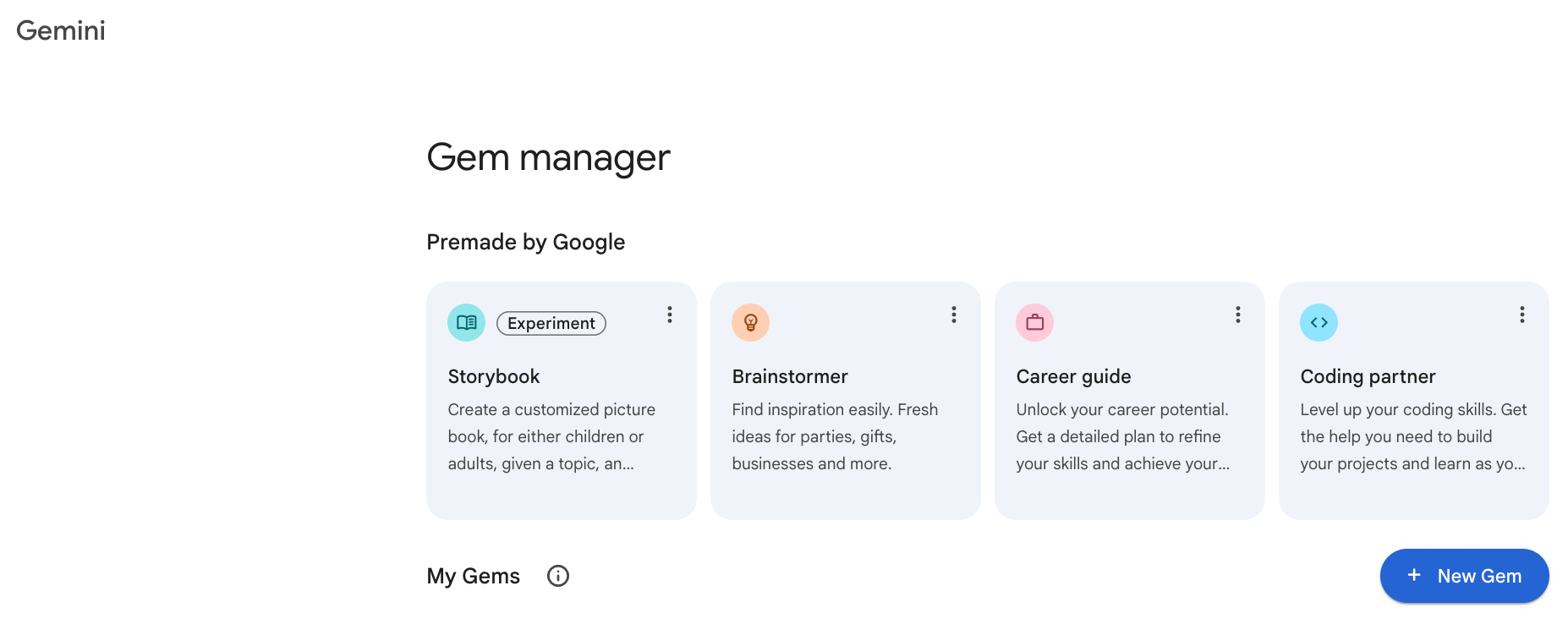
Pro Tip: Loren builds her assistants as both GPTs and Gems so they work in either ChatGPT or Gemini environments.
#4: Test Your AI Assistants
Building the assistant is just the beginning. Testing reveals where your knowledge base needs improvement.
Testing isn't just about accuracy. Ask yourself things like: Is this what I would say? Is this how I would say it? Does the output align with my values and priorities?
For example, you might ask your Leadership Lexicon to reflect back your core values and see whether the answer is accurate. If the AI gets things wrong, go back to the knowledge and see why that must be the case.
The goal is to get as accurate an output as possible, though it will never be 100%. You still need a human in the loop to check outputs. But the more accurate you get through testing, the less human review you'll need.
#5: Integrate Your Leadership Lexicons Assistants in Real Workflows
Once tested, embed your AI assistants into your real work. This is where the actual value shows up.
Leadership Lexicon Case Study: Loren’s Accountability Partner
What makes Loren's Leadership Lexicon powerful isn't just content creation—it's decision-making support. She uses her clone to help make tough calls when she's on the fence about something. In the instructions, she explains why the knowledge exists and how she wants the Leadership Lexicon to use it. She tells it what transformation she wants it to achieve for her.
For example, she asked her Leadership Lexicon whether she should attend a particular conference. It didn't just give her a yes-or-no answer. Instead, it provided a checklist of requirements she had to meet for the trip to be considered a valid ROI. Things like securing a speaking spot and treating it as a strategic networking mission, not just a passive attendance experience.
This is the real value of having a digital clone trained on your values and priorities. It's like having access to a level-headed version of yourself available when you're stressed or in a low-creativity zone. The AI holds you accountable to your own standards and strategic thinking.
Leadership Lexicon Case Study: Beauty and the Bees
Beauty and the Bees is an eco-friendly hair and skin care brand with unique ingredients sourced from Tasmania. When they brought on new staff, training them on which shampoo and conditioner bars worked for different hair types was difficult. The business owner had notes on her phone, FAQs on the website, emails, product lists, price lists, ingredient lists, informational blogs, and brand voice scattered across various platforms.
They pulled together all these important knowledge files, created a custom GPT, and shared it with the team. Now, team members copy Facebook or Instagram messages, put them into the custom GPT, and because it has all that knowledge, it generates the response. The owner no longer has to handle all customer service herself.
#6: Refine Your AI Over Time
Your AI assistants should evolve as your business and expertise develop. Your knowledge needs to comprise living files so AI tools can get smarter and more aligned with you over time, delivering compounding results.
Update things whenever your positioning shifts, when you have shifts in beliefs, or when you develop new frameworks.
Monitor your assistants' outputs for patterns. If something consistently doesn't sound like you or misses the mark, refine the instructions or add more examples to your knowledge base.
Team feedback drives refinement too. When team members report that an assistant's recommendations don't align with how you'd actually handle a situation, investigate what's missing from the documentation.
Refinement is ongoing, not one-time. As your expertise deepens and your business evolves, your AI assistants should become more sophisticated and better aligned with your approach. The compounding results come from this continuous improvement.
Other Notes From This Episode
- Connect with Michael Stelzner @Stelzner on Facebook and @Mike_Stelzner on X.
- Watch this interview and other exclusive content from Social Media Examiner on YouTube.
Listen to the Podcast Now
This article is sourced from the AI Explored podcast. Listen or subscribe below.
Where to subscribe: Apple Podcasts | Spotify | YouTube Music | YouTube | Amazon Music | RSS
✋🏽 If you enjoyed this episode of the AI Explored podcast, please head over to Apple Podcasts, leave a rating, write a review, and subscribe.
Stay Up-to-Date: Get New Marketing Articles Delivered to You!
Don't miss out on upcoming social media marketing insights and strategies! Sign up to receive notifications when we publish new articles on Social Media Examiner. Our expertly crafted content will help you stay ahead of the curve and drive results for your business. Click the link below to sign up now and receive our annual report!
Want to Unlock AI Marketing Breakthroughs?
If you’re like most of us, you are trying to figure out how to use AI in your marketing. Here's the solution: The AI Business Society—from your friends at Social Media Examiner.The AI Business Society is the place to discover how to apply AI in your work. When you join, you'll boost your productivity, unlock your creativity, and make connections with other marketers on a similar journey.
I'M READY TO BECOME AN AI-POWERED MARKETER