by
by Want to know how to create content that AI tools cite and recommend? Wondering how to optimize your website so AI systems treat your business as a trusted source?
In this article, you'll discover how to create content that gets recommended by AI tools like ChatGPT, Claude, and Perplexity, including how to structure your website, repurpose your newsletter, and optimize for AI citations that drive traffic and trust.
Your Business Needs Content for Humans and AI
Most content creators and business owners are still producing content exclusively for human consumption. They write blog posts with story arcs, hooks, and dramatic tension. They structure YouTube videos with a beginning, middle, and end. They craft Instagram posts designed to stop the scroll.
Liron Segev explains that this approach overlooks a fundamental shift underway. Machines are reading content too, and they don't consume it the way humans do. AI doesn't start at the top and read all the way down to the bottom. It doesn't get excited about the setup or look for the payoff.
Each approach to content production is necessary and serves a different audience with different needs. Content for humans still follows the rules marketers have always known. Content for AI follows a different set of rules entirely.
Why AI Is the New Gatekeeper for Business Recommendations
The shift toward AI-driven content mirrors what happened when the internet replaced the Yellow Pages. Liron draws a direct parallel: businesses that once named themselves “AAA Locksmith” to land first in the phone book had to adapt when consumers moved to Google. Some adapted and thrived. Others clung to the old model and disappeared.
That same split is happening now. Roughly 68% of Google search queries no longer result in a click to a website. Consumers are increasingly having private conversations with AI tools instead of opening 29 browser tabs to research a vacation, compare prices, or evaluate service providers.
AI has become what Liron calls the “trusted friend” and “trusted advisor.” When someone asks their AI to plan a three-day road trip, the AI already knows their food preferences, their kids' ages, and their budget. The recommendations it returns are the starting point, and for many users, they're also the endpoint. Businesses that don't appear in those recommendations face a real problem.
#1: How to Lay the Foundation of AI Visibility With Your Website and Newsletter Content
AI doesn't just take a question and find a direct answer. It uses what Liron calls “fan-out queries,” a process where AI automatically generates and executes dozens of related searches beyond the original question. Someone researching a competitor might receive market analysis, pricing data, and analytics they never requested, all because AI inferred the broader intent behind the question.
This means your content that answers a narrow question while also connecting to related topics has a better chance of being surfaced.
The process of getting your business surfaced starts with your newsletter and website.
Most newsletters die after hitting the inbox. Liron's approach turns that dead content into an AI asset.
Once the initial newsletter issue has been sent and performance has been proven, publish the exact same newsletter on your business website so AI can find, crawl, and index it. Then, Liron recommends creating a second version of that newsletter specifically structured for AI consumption, with different headings, keywords, and formatting.
The two versions address two different audiences simultaneously, both living within the same domain.
Marketers Are Learning AI Alone
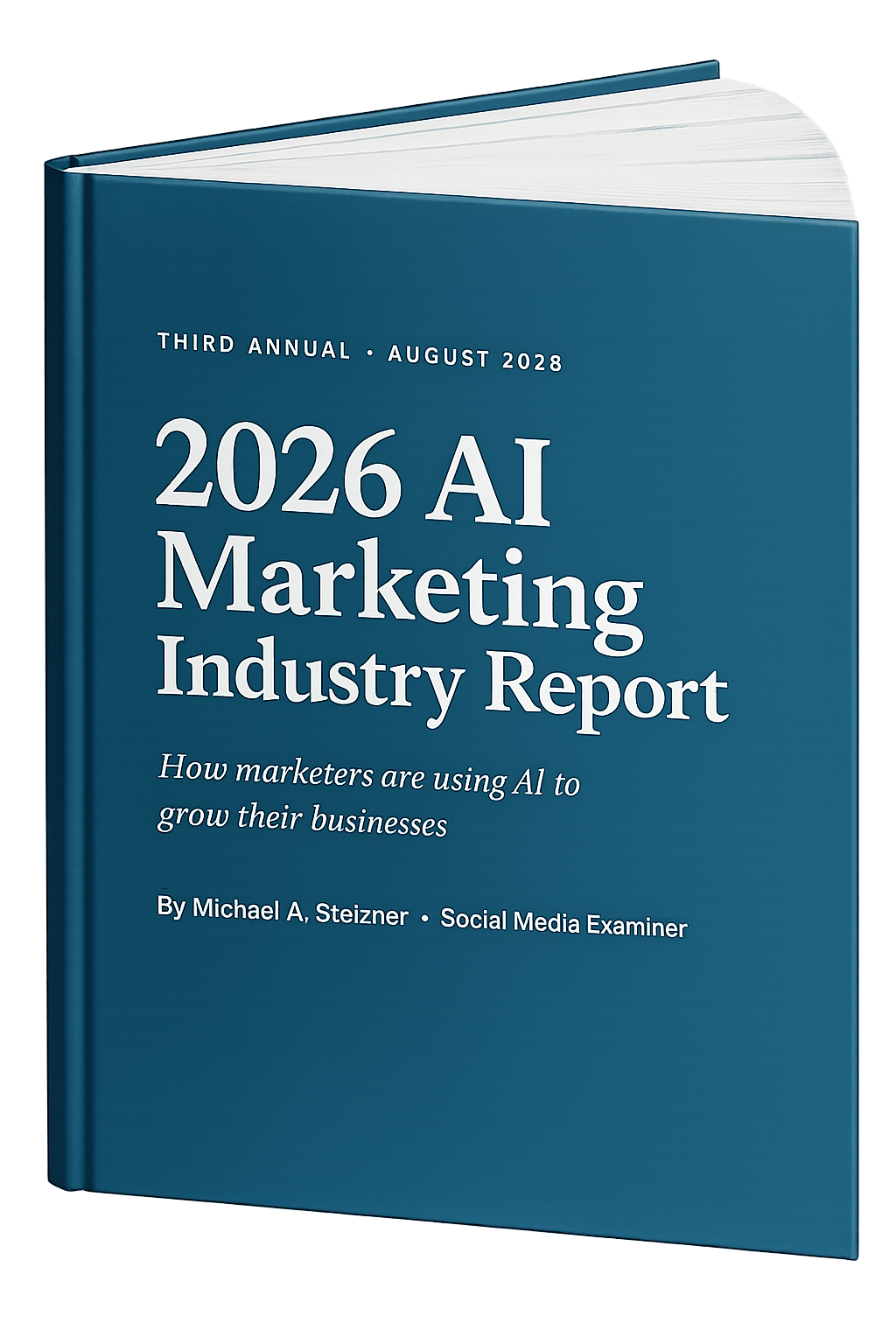
Sound familiar? 85% of marketers learn AI by experimenting on their own, just 7% get company training, and more than half spend their own money on tools.
Our third annual AI Marketing Industry Report surveys 681 marketers and distills everything into 32 clear charts — what's working, what platforms marketers rely on, and what to learn next.
SKIP THE GUESSWORK — READ THE REPORTA Real-World Example: The Consulting Firm
A consulting company was losing to established competitors because the firm couldn't outspend them on ads, and, as Liron points out, ads are renting attention. The second the spending stops, the attention disappears.
Instead of continuing to rent attention via ads, the team analyzed the firm's newsletter archive, identified the highest-performing content based on subscriber engagement, and repurposed it for the website using AI-optimized formatting. They also created fresh content from the same source material, structured specifically for AI consumption.
Within three weeks, the consulting firm owned 72% of its category in AI recommendations. It outstripped competitors who had been publishing content for years and had much larger online followings. The difference wasn't volume or history. It was understanding who the new audience was and how to reach them.
#2: How to Develop Content That AI Cites and Recommends
AI prioritizes content that offers something it can't generate itself. When it searches for an answer, AI has billions of pages to choose from and uses a filtering process to decide which content to surface.
Write to Share Unique Value
The first filter is originality. AI recognizes its own output. If a business published content that AI could have generated itself, there's no additional value to cite.
Liron offers a simple test for your content: if someone can swap your company name in an article for a competitor's name and the content still makes sense, AI has no reason to favor it. That content is generic. It adds nothing that the AI doesn't already have.
What AI wants is content it can't produce on its own. That means personal stories, proprietary data, specific results, and firsthand experience.
A financial advisor who writes “10 Tips for Retirement Planning” is competing with millions of identical articles. A financial advisor who writes about what happened when a specific client restructured their portfolio during a market downturn is providing something unique.
Liron stresses that AI can help create content, but the output needs personal enrichment. A generic prompt asking AI to write “seven things to do in Anaheim” produces generic content AI will never cite. Content built using AI as a drafting tool but enriched with personal stories, specific data points, and firsthand experience gives AI something it can't generate on its own.
Liron gives the example of a conference organizer writing about what attendees should do before an event.

Which AI Moves Actually Matter?
That's what every marketer is wrestling with now. New AI strategies, new tools, new takes every week — but no clarity. Most marketers and business owners are trying to figure out AI alone.The AI Business Society is your trusted guide. Get expert-led training you can put to work immediately. Plus a community of marketers sharing what's actually working.
I'M READY FOR REAL AI RESULTSA generic list of local attractions is forgettable. But content that references specific experiences from past events, mentions how many people attended a particular dinner, or describes a specific restaurant discovery from the previous year becomes unique. AI's predictive algorithms recognize personal details as a source of added value.
Structure Content for AI
AI doesn't read an article from top to bottom. It uses a process Liron calls “chunking”: the extraction of a specific, self-contained piece of content from a larger article that directly answers a user's question. That chunk is pulled out and returned to the user, often with a citation linking to the source.
This changes how content should be structured.
Each section of your content needs to stand on its own, making sense without the paragraphs that come before or after it. If AI can extract a two- or three-sentence answer that's accurate, unique, and useful, it will use that chunk and attribute it to the source.
#3: How to Build an AI Content Strategy for Getting Recommended by AI
When AI repeatedly pulls from the same business's content, that business builds compounding authority. Users who see the same name appearing across multiple AI responses start to trust that brand, the same way they'd trust a friend who keeps recommending the same restaurant.
To become that trusted source, traditional marketing principles still apply. Understanding the audience's psychographics, what keeps them up at night, what confuses them, and what they need to make a decision, drives the entire content strategy for AI.
Liron recommends mining existing business data for content topics. Support tickets reveal the problems customers actually face. Sales calls surface recurring questions. The rule from every college lecture hall applies: if one person asks a question, dozens of others had the same question but didn't raise their hand.
The key is mapping the full customer journey, not just the bottom-of-funnel purchase decision.
A real estate agent specializing in first-time home buyers in Phoenix, Arizona, shouldn't only write about buying homes. Liron explains that potential buyers start much higher up the funnel. They're asking whether Phoenix is safe, what the school systems are like, what the HOA rules are, and what the property taxes are like.
The agent who answers all those questions across separate pieces of content builds AI-driven authority at every stage of the journey.
#4: The Technical Setup for Getting Recommended by AI
Beyond content strategy, there's a technical layer that determines whether AI can even access a business's content. Liron outlines several checkpoints.
Apply a Q&A Format to Content: Liron recommends formatting your content with clear questions and direct answers. The answer should appear within the first 100 words. Each answer should be written with the target audience in mind, so when AI chunks it out, the extracted piece speaks directly to the person who asked.
Check the Robots.txt File: Legacy settings on your website may be blocking AI crawlers without you knowing. Liron has worked with several businesses that couldn't get traction in AI recommendations, and the problem turned out to be a robots.txt file that disallowed AI access entirely.
Review Cloudflare Settings: Cloudflare includes an AI blocker feature. Liron notes it should be off by default, but some users have found it turned on without their action. Checking this setting takes minutes and could remove a significant barrier.
Minimize JavaScript Rendering Issues: Pages that render based on user interactions, scroll-triggered content, or dynamically loaded elements can be difficult for AI to parse. Static, straightforward HTML content is easier for AI to crawl and understand.
Maintain Active Sitemaps: An XML sitemap is standard for machine readability, but Liron recommends also maintaining an HTML sitemap. Having both formats gives AI two entry points to discover content.
Your pages don't need to be linked from the main navigation menu to have value. As long as the sitemap references them, AI can still crawl and index them. For WordPress users, this means content can live on a page rather than a blog post, unlinked from the main menu but still fully discoverable through the sitemap. Liron notes that several clients have published their entire newsletter archive this way, keeping the content crawlable and indexable without cluttering the site's navigation.
Use Structured Data and Schema Markup: FAQ schemas, list schemas, and other structured data formats help AI understand content organization. All existing SEO best practices still apply. Liron emphasizes that SEO isn't dead. It simply has a different feel when the audience includes machines as well as humans.
Liron Segev is an AI strategist who helps business owners create content that gets recommended by AI. His company, Answer Content Engine, offers a free AI audit tool to assess your business’ position in AI recommendations. Follow him on YouTube, X, and LinkedIn.
Other Notes From This Episode
- Connect with Michael Stelzner @Stelzner on Facebook and @Mike_Stelzner on X.
- Watch this interview and other exclusive content from Social Media Examiner on YouTube.
Listen to the Podcast Now
This article is sourced from the AI Explored podcast. Listen or subscribe below.
Where to subscribe: Apple Podcasts | Spotify | YouTube Music | YouTube | Amazon Music | RSS
✋🏽 If you enjoyed this episode of the AI Explored podcast, please head over to Apple Podcasts, leave a rating, write a review, and subscribe.
Stay Up-to-Date: Get New Marketing Articles Delivered to You!
Don't miss out on upcoming social media marketing insights and strategies! Sign up to receive notifications when we publish new articles on Social Media Examiner. Our expertly crafted content will help you stay ahead of the curve and drive results for your business. Click the link below to sign up now and receive our annual report!
Discover Proven Marketing Strategies and Tips
Want to go even deeper with your marketing? Check out the Social Media Marketing Podcast! Publishing weekly since 2012, the Social Media Marketing Podcast helps you navigate the constantly changing marketing jungle, with expert interviews from marketing pros.
But don’t let the name fool you. This show is about a lot more than just social media marketing. With over 650 episodes and millions of downloads each year, this show has been a trusted source for marketers for well over a decade.